Making Cellular Networks More Efficient By Roaming-in-Place¶
Roaming – in which an operator 𝐴 directs its users to connect to the infrastructure of a different operator 𝐵 – has long been a central feature of cellular networks, allowing 𝐴 to ensure that its subscribers enjoy coverage even in areas where 𝐴 lacks cellular infrastructure. In this paper, we explore the feasibility and benefits of generalizing roaming as follows: consider a scenario in which operators 𝐴 and 𝐵 both have towers (denoted𝑇 𝑎 and𝑇 𝑏 respectively) in the same vicinity but perhaps 𝑇 𝑎 is overloaded while 𝑇 𝑏 has spare capacity, or perhaps certain users in that vicinity enjoy better performance to 𝑇 𝑏 than to 𝑇 𝑎 . At such times, when a user 𝑈 , who is a subscriber of 𝐴, attempts to connect to 𝑇 𝑎 , operator 𝐴 may (re)direct 𝑈 to instead attach to 𝑇 𝑏 .
We call this generalization Roaming-in-Place (RinP) because the mechanism is essentially identical to roaming, only that it is not limited to scenarios where 𝐴 has no deployments. In this paper, we present the design, implementation and evaluation of the RinP idea, demonstrating that RinP is practical: our design requires no modification to existing cellular standards, only modest changes to existing cellular core implementations, and can be incrementally deployed with immediate benefit to early adopters.
We argue that RinP is a valuable feature because it unlocks two important benefits for operators: (1) efficient capacity scaling, particularly in dense high-demand areas such as large cities, and (2) the ability to provide users with higher availability and performance service level objectives (SLOs). In what follows, we briefly expand on these benefits.
More efficient capacity scaling. The current cellular infrastructure has over 8B subscribers and carries over 190EB per month, yet bandwidth demand continues to grow exponentially with no end in sight [30]. The traditional approach to meeting this demand is via densification, where operators deploy more base stations per unit area, enabling better spatial reuse of spectrum. To date, this has been an effective – though quite expensive – approach with users enjoying data rates that typically double every two years, a scaling trend referred to as Cooper’s law [23].
Wireless experts have long warned us that Cooper’s law will eventually slacken because, beyond a certain point, denser deployments lead to increased interference and hence sub-linear capacity scaling. Unfortunately, these expert analyses reveal that we are now approaching this point of diminishing returns, a shift they liken to the end of Moore’s law and its impact on computing efficiency [14, 24, 46]. This raises the question: Can we enable more efficient capacity scaling, particularly in dense high-demand areas such as large cities?
To date, efforts to increase capacity through more spectrum and spectral efficiency have contributed a fairly small fraction of total growth [14]. Thus, we need other ways to scale capacity efficiently. A commonly suggested approach for building cost-effective infrastructure is sharing infrastructure across operators and various forms of passive and active sharing have been explored over the years. However, as we discuss in §2, these approaches often focus on challenges other than densification, or are less effective in dense high-demand areas where operators are unlikely to have excess resources to allocate to others on a long-term basis.
Taking a step back, we observe that previous efforts to share infrastructure were often intended to address the need for cost-efficient coverage (e.g., two operators agreeing to share infrastructure in remote areas where neither can individually provide coverage in a cost-effective manner). Another example of this are Mobile Virtual Network Operators (MVNOs) entities that pool multiple operators together to improve their user’s coverage. However, our focus is on sharing in high-demand areas where deployments are dense, and this places a very different set of requirements on sharing. In particular, to be effective in such contexts we need resource sharing that is fine-grained: i.e., we must assume that neither 𝐴 nor 𝐵 has significant unused resources to allocate over long timescales and instead we must be able to exploit smaller temporal variations so operators can avoid provisioning for peak (or close) demand. In short, we need statistical multiplexing at a finer granularity than is typically achieved by active sharing today than is typically achieved by MVNOs or active sharing today. For example, as discussed in §2.4, MVNOs typically leverage a small number (1-2) of MNOs with a single primary MNO and others as backup during lack of coverage conditions.
In this paper, we argue that (RinP) can help us deal with the problem of densification. We should make clear that RinP does not “solve” the problem of scaling cellular capacity, which remains a huge undertaking to cope with the growing needs. All we are claiming is that RinP helps offset some of the problems that arise with densification and the loss of linear scaling in capacity as more infrastructure is deployed.
Improved availability and performance. Even with well provisioned mobile networks, emerging applications are pushing our limits on both performance and availability. Applications, e.g., AR/VR, autonomous vehicles, and AI serving, demand ever-higher bandwidth and lower latency [11, 49, 56, 70]. Simultaneously, the growing adoption of cellular technology in the digitalization of traditional infrastructures (e.g., grid [71], water [33]), health, and critical services means that any downtime comes at a high cost, as evidenced by recent outages that affected 911 services [65, 66].
In datacenters, operators meet such demands by deploying redundant infrastructure (e.g., with dual top-of-rack switches for failover, overprovisioning to absorb demand spikes, and etc.), but doing the same for cellular infrastructure would be impractically expensive. This leads to the question: Is there an efficient approach to improving the performance and availability SLOs that cellular operators offer their users?
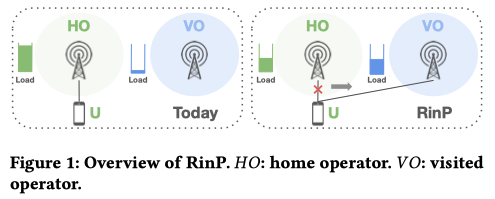
We propose RinP as one approach to meeting the above challenge. Using RinP, an operator can address outlier events - e.g., poor performance due to localized interference, a tower failure, load spikes – by opportunistically leveraging the infrastructure of a different operator. Prior work, such as [57], has shown that user driven selection of operators can improve performance. With RinP’s network-driven approach, however, an operator can also use insights from inside their network (e.g., tower load), as seen in Figure 1, to improve performance and availability for their users. RinP gives the operator detailed control over when to redirect a subscriber to another operator, thus providing a fine-grained knob by which operators can manage performance anomalies and failure.
As with capacity scaling, we recognize that RinP does not improve the average case of performance and availability. It merely offers an efficient approach to improving the tail in performance or availability metrics. Similarly, RinP’s benefits are reduced if operators experience highly correlated conditions, though our results in §5.2 show that RinP achieves valuable benefits up to a significant degree of correlation.
RinP is an extreme form of the general notion of user sharing that has been proposed before [18, 48, 74]. However, to date, user sharing has been primarily of theoretical interest and typically studied from the viewpoint of improving coverage rather than as a solution to the challenges increasing user demand (§7). In addition, RinP is largely orthogonal to MVNO architectures and traditional forms of infrastructure sharing and is designed to address technical challenges of a more efficiently and plausibly deployable system. These challenges are:
(1) To be effective, it must enable fine-grained and flexible sharing: RinP’s load-balancing is implemented per-user, per-tower and can vary in time. The decision to redirect a user is up to the operators involved and can be based on diverse factors such as performance, load, costs, etc.
(2) To be deployable, it must be minimally disruptive to the existing cellular infrastructure: RinP reuses existing roaming mechanisms and as such is largely a shift in policy vs. a modification of cellular architecture or implementation. RinP could be used with existing phones with minor changes and network infrastructure with only over-the-top changes.
(3) To be deployable, it must be minimally disruptive to operational practice: RinP can be realized as a simple extension to existing roaming agreements and does not require operators to cooperate in operating their infrastructure. Moreover, policy is not only fine-grained but need not be decided a priori, so operators can decouple building/operating their network from policies on when and where to offer RinP.
(4) To be future-proof, it must continue to provide benefits even at greater densities of deployment: RinP’s efficiency gains improve with densification. This is because the demands from each operator at a given location are increasingly de-correlated as density increases, which in turn creates more opportunities for fine-grained sharing (§5.2).
In this paper, we review relevant background (§2) and then present the detailed design (§3) and implementation (§4) of RinP. We benchmark the overheads of our implementation (§5.1) and use simulation and small-scale experiments to evaluate the potential benefits of RinP (§5.1-§5.3).
本文Introduction部分的核心内容可以概括为以下四个方面:
-
提出“就地漫游” (RinP) 概念:
- 传统漫游主要用于无网络覆盖区域,而RinP将其泛化到了覆盖重叠区域
- 当运营商A的基站过载时,可将用户动态重定向至有空闲容量的运营商B的基站(如Figure 1所示)
-
核心优势一:优化网络容量扩展效率:
- 传统的 "增加基站密度(密集化)" 手段,正面临干扰增加和收益递减的瓶颈
- RinP 能够在高需求密集区域提供比传统 "基础设施共享" 或 MVNO 更细粒度的统计复用,缓解容量扩展压力
-
核心优势二:提升服务可用性与性能:
- 通过网络端主动控制,运营商可以利用其他网络的基础设施来应对基站故障、局部干扰或负载激增等异常事件,从而低成本地提升用户的服务水平目标(SLO)
-
设计的四大实用性与部署原则:
- 细粒度与灵活: 支持基于每个用户、每个基站及随时间变化的动态负载均衡
- 基础设施破坏性极低: 复用现有漫游机制,手机和核心网只需微调或应用层(over-the-top)修改,无需改变现有标准
- 运营无缝衔接: 仅是现有漫游协议的简单扩展,不要求运营商联合运营网络
- 面向未来: 随着基站密度增加,运营商间的需求差异性增大,RinP的共享效率反而会更高
Background¶
We briefly provide background on current cellular networks.
2.1 Cellular architecture
Cellular networks today are divided into the Radio Access Network (RAN) and the mobile core. The RAN consists of radio towers (called gNodeBs for 5G and eNodeBs for LTE) that connect to user equipment (UE), such as mobile phones. It manages the radio spectrum, making sure it is used efficiently and meets the quality-of-service requirements of every user. The mobile core connects the RAN to the rest of the Internet and manages the databases storing user information (e.g., service plans, usage, and etc.). The functions of the RAN, each component in the core network, and the communication between components and UEs, are defined in the 3rd Generation Partnership Project (3GPP) specifications. However, the implementation of each component is left to the operator’s discretion. Instead of describing every part of the cellular core in detail, we focus on two components that are key to RinP: the Mobility Management Entity (MME) in LTE and the Access and Mobility Management Function (AMF) in 5G. The MME and AMF are responsible for managing UE mobility and authentication.
When a UE is turned on and wants to connect to a mobile network, it performs the cell selection procedure, which consists of two phases: camping to the cell, which involves tuning to the appropriate frequency and synchronizing with the cell’s broadcast control channel and attaching to the network Initially camping to a network requires scanning multiple frequency bands to identify nearby eNBs and available networks. The UE then chooses a tower to connect to using a 3GPP-specified procedure based on the home operator’s Public Land Mobile Network (PLMN), or identifier, as specified in its Subscriber Identity Module (SIM) card and signal strength [7]. After camping, the UE “attaches” to the network [5]. This procedure includes authentication of the user and setting up of user plane and control plane connections, so the UE’s traffic can be processed in the network. When a UE moves around in the physical world, it may need to “handover” to a cell that provides better signal quality. To do this, each cell shares information about the frequencies of adjacent "neighbor" cells to its attached UEs; a UE camped to a cell continually measures signal quality to these neighbor cells and reports this information back to the cell to which the UE is currently camped, which in turn uses these measurements to determine when to trigger a handover.
The RAN and core coordinate to handover the UE with minimal disruption to the connection. An eNodeB or gNodeB triggers a handover for a user when the UE measures a better signal quality from a neighboring cell. The adjacent cells can exchange user state via the appropriate interfaces (X2 for LTE or Xn for 5G), so the user can switch immediately to using the neighboring tower without having to go through the attachment process again. If those interfaces are not supported in the implementation being used, the MME/AMF must be involved to pass the user state through the connections between the tower and the core (S1 for LTE and NG for 5G) [3]. If the target neighboring cell is not connected to the same MME/AMF, the two MME/AMFs must communicate the user state through an additional interface (S10 interface between MMEs and the N14 reference point between AMFs).
2.2 Roaming today
When a UE enters an area where its home operator does not have any towers available and thus has no coverage, the UE attempts to “roam” by attaching onto an available tower. This roaming attachment only succeeds, however, if the visited operator has a roaming agreement with the UE’s home operator. This roaming agreement may come in the form of a bilateral agreement or they may be established through an IP Packet Exchange Provider (IPX-P). IPX-P’s provide the infrastructure and functionality that enables roaming, such as building the data tunneling (GTP-U) between operators, and settling the billing between operators [61, 62].
Traditional roaming agreements, however, only occur in nonoverlapping areas of coverage, such as different operators having coverage in different countries, and hence does not help operators combat the costs of scaling and densification in the areas they both cover. Domestic/national roaming agreements exist that enable roaming between operators within the same country, but they too are only enabled in areas of non-overlapping coverage [39]. RinP on the other had assumes that the operators have RAN deployments in the same geographical region and both own their own separate spectrum and mobile core deployments.
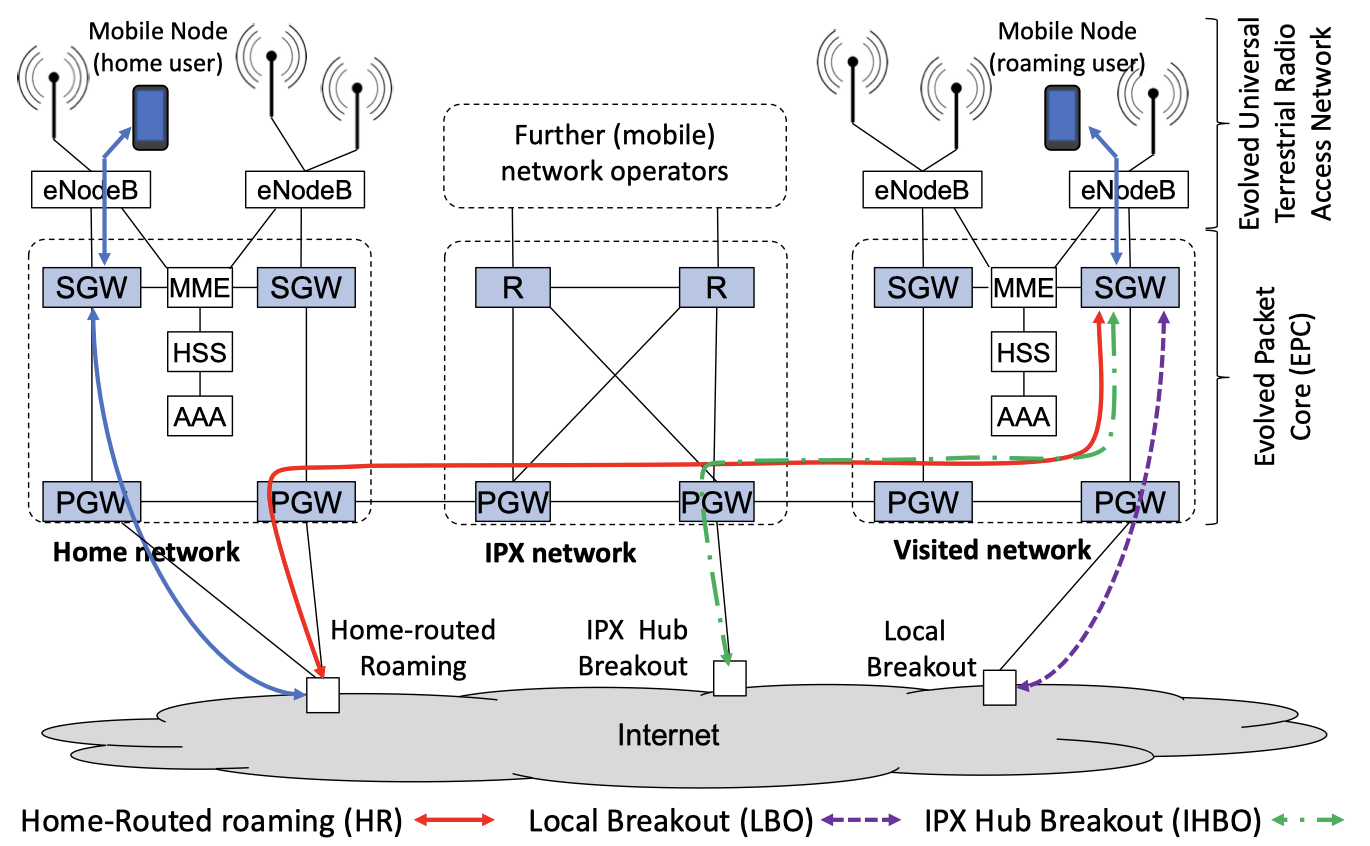
The attachment procedure for roaming is largely the same as an attachment to a home operator tower, with three key changes. One change is during the tower selection procedure, the UE will preferentially select a tower to attempt to attach to based on an ordered list of roaming PLMNs listed in the SIM called the “Operator controlled PLMN Selector with Access Technology” [2]. As the name suggests, a UE’s home operator configures this ordered list based on its roaming agreements and policy. Another change is that, in order to authenticate the UE, the visited operator core will communicate with the home operator core (e.g., through, in LTE, the S6a interface [4] and, in 5G, the N32 reference point [41]). Finally, in order to enable billing of roaming traffic between operators the UE’s data plane traffic may be routed differently. There are currently two options for routing roaming traffic: home routing and local breakout (LBO) [4]. Home routing is more widely deployed [29] and reroutes user traffic through the gateway of the home operator (through, in LTE, the S6 interface and in 5G, the N9 reference point [41]). In contrast, with LBO, users’ traffic is routed locally through the visited operator’s gateway, incurring lower latency and inter-operator traffic. This gain in efficiency comes at the cost of transparency: in home routing inter-operator migrations do not change the user’s IP address, whereas LBO migrations do. RinP reuses the above procedures with no change.
2.3 Infrastructure Sharing
Various forms of infrastructure sharing have been explored in the literature, including:
(i) Passive sharing: in which operators share non-networking infrastructure, e.g., buildings, towers, and power. This amortizes cost but does not fundamentally change the network capacity an operator must deploy to meet growing demands, and hence does not address the challenges of densification.
(ii) Active sharing: in which an operator 𝐴 allocates a portion of its network infrastructure for use by an operator 𝐵. Active sharing can take many forms depending on the resources being shared (spectrum, radio, baseband, backhaul), who operates the allocated resources (𝐴, 𝐵, or jointly), who owns the corresponding spectrum (𝐴 or 𝐵), etc. Regardless of the specifics, in practice the allocations are typically coarse-grained and static (e.g., one operator allows another to use a fixed portion of their spectrum for a year or more).
This makes traditional active sharing less effective in dense highdemand areas where operators are unlikely to have excess resources to allocate to others on a long-term basis.
One might ask: can we extend active sharing to make fine-grained allocations? This is possible in principle, but in practice we believe this would be challenging and disruptive at both the technical and operational levels. On the technical front, it would require implementing fast and fine-grained resource allocation/revocation which in turn involves new mechanisms for virtualizing resources – such as the aforementioned radio, baseband, and backhaul – then providing mechanisms for scheduling those resources, enforcing isolation between those resources, and accounting for the use of those resources. It is worth noting here that even basic network/RAN slicing, which is a strict subset of what would be needed for fine-grained active sharing, has been many years in development and is still far from widely deployed [32, 63]. Perhaps more importantly, fine-grained active sharing would pose significant operational challenges, since it would require that operators cooperatively implement dynamic resource scheduling. To our knowledge, the only networks that have undertaken such cross-operator cooperative management involve subsidiaries that are under a common administrative entity [17, 69]. Finally, we note that, as currently implemented, neither active nor passive sharing helps with improving users’ performance or availability SLO, which is one of the benefits we target with RinP.
2.4 Mobile virtual network operators (MVNOs)
In MVNO architectures - e.g., Google Fi [37] – a virtual operator (MVNO) acts as a broker between users and one or more infrastructure operators (MNOs). Most MVNOs today use one MNO; when an MVNO has multiple MNOs, it is for coverage in regions where the MNOs do not have overlapping coverage, rather than load-balancing or performance optimization. e.g., users with Fi can switch between networks automatically triggered by the loss of service 1 . However this is not a part of the 3GPP standards and is only enabled for phones that have the proprietary Fi UE baseband that enables this [36], which restricts the adoption and efficacy of this architecture. In principle, an MVNO could load-balance users between MNOs in the dynamic and fine-grained manner that RinP advocates although it is unclear that MVNOs have as much incentive to do so since infrastructure efficiency is a more immediate concern for MNOs.
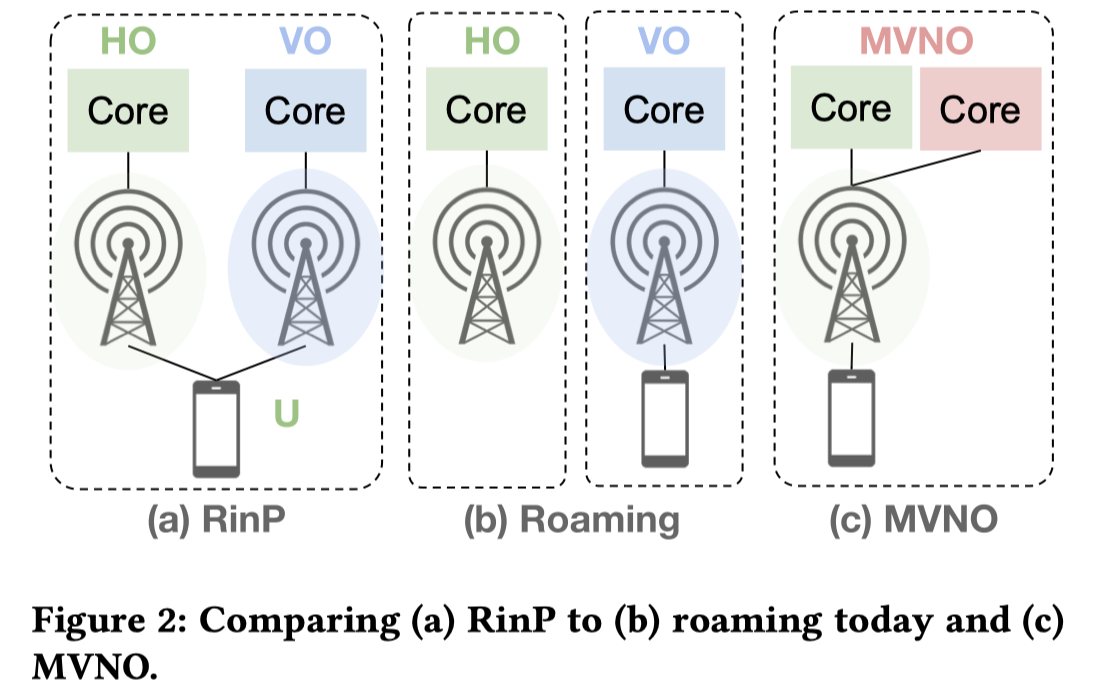
Architecturally, MVNOs may operate their own mobile core infrastructure (at least the control place functions) but they do not operate their own RAN infrastructure. Rather they rely on MNO infrastructure to serve all their customers by leasing a portion of the MNO’s RAN and leasing MNO spectrum. Conversely, RinP assumes that the MNOs using RinP own their own spectrum and have RAN deployments in the same geographical region. This difference is portrayed in Figure 2.
主要梳理了当前蜂窝网络的相关概念,并对比了 现有技术 与 本文提出的RinP 的区别,核心内容可以概括为以下四点:
-
蜂窝网络架构基础 (2.1):
- 现代蜂窝网络主要由无线接入网(RAN)和移动核心网组成
- 该部分重点介绍了与RinP高度相关的 核心网移动性管理组件
- LTE中的MME, 5G中的AMF
- 以及 UE 接入网络的过程(驻留与附着)和基站间的 Handover 机制
-
现有漫游机制的局限性 (2.2):
- 现有的漫游(包括国际漫游和国内漫游)通常仅限于运营商网络覆盖不重叠的区域
- 因此无法解决重叠区域内的网络密集化和容量扩展问题
- RinP与此不同,其前提是: 运营商在同一地理区域内均部署了基站,且各自拥有独立的频谱和核心网
-
基础设施共享方案的不足 (2.3):
- 业界现有的被动共享(共享铁塔、建筑等硬件)和主动共享(如频谱或基带的长期粗粒度分配)均无法有效应对高需求密集区域的挑战
- 在现有技术下,实现动态、细粒度的主动共享面临极高的技术和运营壁垒,且这些共享方式无法提升用户的性能或可用性目标(SLO)
-
MVNO 架构的差异 (2.4):
- MVNO(如Google Fi)作为虚拟运营商,本身不拥有无线接入网(RAN)基础设施或频谱,而是通过租赁其他移动网络运营商(MNO)的资源来提供服务
- 相反,RinP涉及的MNO各自拥有独立的频谱和RAN部署
- 如 Figure 2 所示,该图直观地对比了:
RinP/传统漫游/MVNO在架构上的本质区别
积累
- Roaming:
- 定义: 连接 OpA, OpA 和 HOp 有合作协议, "回传"到 HOp
- Motivation: "覆盖率不足" -> "不同的 Op 协作"
- 方式:
- Home Routing: OpA 和 HOp 有合作协议, "回传"到 HOp
- LBO: OpA 直接本地处理
- Infra Sharing:
- passive sharing: 共享 non-network infra
- buildings, towers, and power
- active sharing: 共享 network infra
- spectrum, radio, baseband, backhaul
- passive sharing: 共享 non-network infra
- MVNO:
- 定义: a virtual operator (MVNO) acts as a broker between users and one or more infrastructure operators (MNOs)
- 形式: UE -> MVNO -> Multiple MNOs
- 目的: 一个不能用时, 切换到另一个
- 不是为了 LB!!!
- MVNO 没有自己的 RAN, 有自己的 Core
- Roaming / MVNO / RinP 对比:
Design of Roaming-in-Place¶
这篇论文的“就地漫游设计(Design of Roaming-in-Place)”部分详细阐述了RinP的系统架构与工作流程,其核心内容:
(1) 设计目标与前提协议:
- RinP的核心设计原则是易于部署且干扰最小化
- 它不需要修改任何3GPP标准协议,只需运营商内部进行适度的配置调整或增加应用层(over-the-top)组件
- 在使用RinP之前,合作的运营商必须预先建立类似于传统漫游的RinP漫游协议
常见修改方式
- 网络侧修改: the internals of an operator’s network (e.g., policy or software component)
- 端侧修改: UE software / hardware new design
- 协议修正与更新: (e.g., headers, signaling messages)
- most difficult!
(2) 就绪服务 (Readiness Service):
RinP引入了一个独立于底层网络的应用层服务。
每个运营商在各区域部署就绪服务器,这些服务器负责收集本网基站的负载和状态信息,并通过API向合作运营商广播其基站是否“就绪”(即: "是否有可用容量接收漫游用户"),从而实现目标基站的发现与选择。
(3) 漫游切换流程 (Roamover):
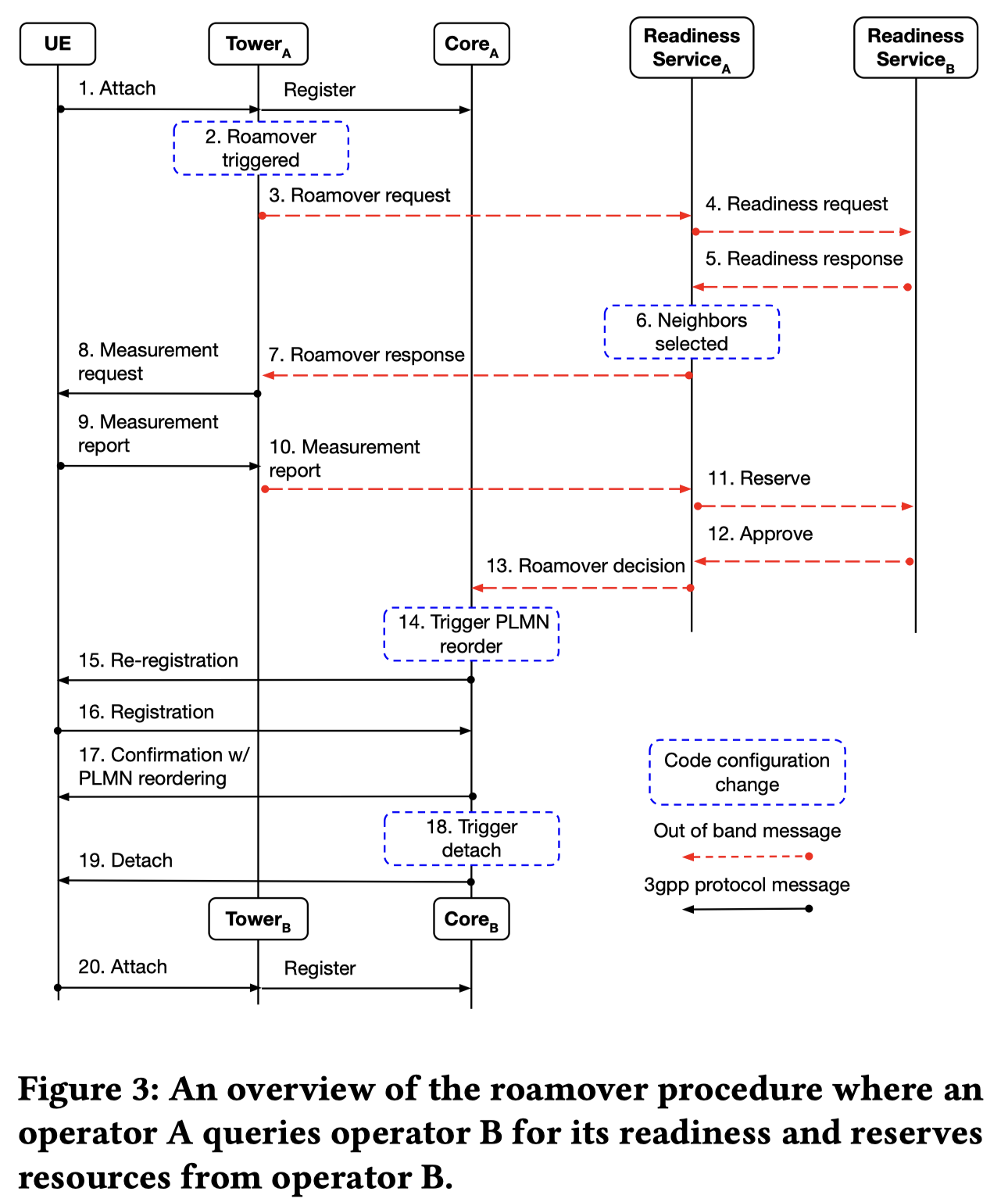
这是 RinP 的核心执行过程。该过程包含三个关键步骤:
- 选择与预留:
- 当基站(因负载过高或用户性能差)决定切换用户时,会向就绪服务器发起请求,安排用户设备(UE)进行信号测量,并最终在目标网络中预留合适的基站
- EPLMN列表重排:
- 原网络核心网通过配置下发,更新UE设备内的等效公共陆地移动网络 (EPLMN)优先级列表
- 确保UE在断开后会自动优先选择目标运营商
- 断开与重连:
- 核心网发送带有特定拒绝代码的断开连接(Detach)指令,迫使UE断开当前网络并触发网络搜索
- 随后:UE将无缝 "附着(Attach)" 到预设好的目标网络中
(4) S10/N14 接口切换优化 (S10/N14 Optimization):
为了进一步减少上述 “断开-重连” 带来的网络中断时间,RinP提出了一种优化方案。
利用3GPP标准中现有的 S10(LTE网络)或 N14(5G网络)接口,运营商可以直接执行跨核心网的平滑切换(Handover),直接转移用户上下文状态而无需设备重新注册。
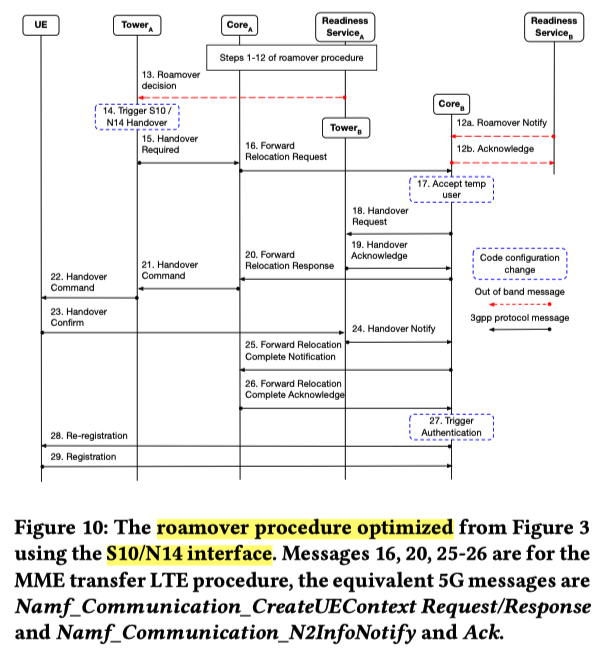
设计机制讨论
RinP坚持由 网络端(运营商)驱动 切换而非用户设备驱动,从而防止频繁的“乒乓切换”并保障运营商的控制权。
同时,该设计直接复用了现有IPX-P漫游的安全与隐私保护机制,将具体的切换策略(何时切、切给谁)留给运营商自行制定。
Related Work¶
| 相关研究领域/技术 | 代表性工作/技术 | 与 RinP 的核心差异或联系 | RinP 的独特优势/特点 |
|---|---|---|---|
| 蜂窝网络基础设施共享 (Infrastructure sharing) | 多种物理网络设备共享形式 (如 MOCN) [10, 20, 21, 25, 28, 39, 51] | 传统共享涉及运营商共同实施弹性的资源管理;RinP 则是跨独立管理的基础设施对用户进行负载均衡。 | 事后 (post-hoc)、动态、细粒度的负载均衡;无需提前规划和配置;可作为主动共享的互补方案。 |
| 移动虚拟网络运营商 (MVNOs) 架构 | Google Fi 等现有 MVNO 架构 [35] | 现有 MVNO 架构的设计初衷并非网络效率或细粒度的性能提升;RinP 主要适用于更普遍的传统 MNO (移动网络运营商) 模型。 | 聚焦于提升 MNO 架构 下的网络容量和性能。 |
| CellBricks (UE 驱动的移动性) [60] | 该方案局限于 MVNO 模型,且未将基础设施效率作为动机;RinP 解决的是 MNO 模型的问题。 | 适用于更广泛的 MNO 模型,兼顾性能与基础设施效率。 | |
| Magma (最小化移动性支持的核心网) [47] | 发现许多用例无需复杂的移动性;RinP 可以应用于此类 Magma 网络中。 | 兼容性强,可部署于简化移动性支持的新型网络架构中。 | |
| 漫游引导 (Steering of Roaming, SoR) | SoR 技术 [1, 2, 42] | SoR 仅在归属网络不可用时才生效;RinP 能够在覆盖重叠的情况下实现用户共享。 | 打破覆盖盲区限制,实现重叠覆盖区域内的动态资源共享。 |
| 多接入 (Multi-access) 技术 | 双 SIM 卡和双栈手机 [43, 44] | 可实现无运营商干预的用户驱动型 RinP (互补方法),但无法带来基础设施效率的提升;当前双栈多射频手机并不普及。 | 相比硬件受限的用户端方案,网络端方案更易部署且能带来基础设施效率增益。 |
| iCellular [57] | 依赖 UE 侧的间接指标进行预测和动态切换;RinP 由运营商驱动,基于对基站负载和 UE 性能的直接掌握来做决策。 | 决策基于全局且直接的网络内部状态 (如负载、性能),而非用户端的局部猜测。 | |
| CellFusion [67] | 针对自动驾驶,同时使用多家运营商的网络 (利用多接入);RinP 是在运营商间切换。 | - | |
| 用户共享 (User sharing) 理论研究 | 降低基站能耗相关的理论研究 [16, 18, 19, 53–55, 64, 68] | 现有研究多出于理论探讨且动机多为节能,未涉及动态卸载用户的系统和协议问题,也未考虑密集化成本的影响。 | 填补了理论到实践的空白,解决了具体系统和协议问题,并聚焦于应对网络密集化挑战。 |
| Berry et al. (博弈论研究投资意愿) [18] | 发现只要运营商优先满足自有用户,用户卸载就不会降低投资意愿 (RinP 在仿真中采纳了此策略)。 | 采纳了保证运营商利益的合理策略,证明了 RinP 的商业可行性。 | |
| 802.11 无线漫游 (Wi-Fi) | 802.11r/k/v 标准 [50] | Wi-Fi 漫游针对的是同一 SSID 下的基站切换,不涉及不同 SSID 间的漫游;RinP 解决的蜂窝架构问题等同于跨 SSID 漫游 (需要断开和重新认证)。 | 解决了跨独立网络身份认证域(相当于跨 SSID)的无缝或低延迟切换难题。 |
Conclusion¶
RinP extends roaming so that users can dynamically roam between networks in overlapping coverage zones, based on load and service quality.
Thus, RinP achieves efficient capacity scaling for operators and user performance improvements.
RinP can be adopted by operators with minimal changes to the existing cellular infrastructure, by avoiding changing the standard protocols or requiring cooperative resource sharing.