RANPilot: Making AI Functionalities Robust to Dynamic O-RAN Reconfigurations¶
一、 研究背景与核心痛点
- O-RAN的机遇与挑战:
- 开放无线接入网(O-RAN)通过解耦架构和AI驱动(如xApps)带来了前所未有的灵活性,使网络能够动态重新配置
- 数据漂移导致AI失效:
- 当网络进行常规重构或升级(例如添加新基站、调整硬件/软件参数、更改控制策略)时,会引发严重的“数据漂移(Data Drift)”
- 这会导致原本在旧配置下训练良好的AI模型性能急剧下降甚至失效
- 现有方案的局限性:
- 目前的标准解决方案是 Reactive Retraining,即在重构后收集新数据再微调模型
- 这种方法极其缓慢,会导致AI服务经历长达数十分钟的停机(Downtime)或 suboptimal 状态,抹杀了 O-RAN 动态灵活的优势
二、 核心解决方案:RANPILOT框架
针对上述问题,作者提出了 RANPILOT:
首个通过主动式AI自适应(Proactive AI Adaptation)来解决重构挑战的框架
它的核心理念是将AI演进的范式从“被动补救”转变为“主动准备”,在物理网络重构发生之前,就让AI模型提前适应新的网络状态
三、 系统设计的三大核心模块
- 虚拟O-RAN与数据合成 (Virtual O-RAN):
- RANPILOT构建了一个轻量级的、由真实历史轨迹驱动的仿真器(Virtual O-RAN)
- 它不依赖于沉重的物理层射线追踪,而是专注于控制层和数据层的逻辑交互:
- 在实际物理重构发生前,合成出具有高保真度的目标状态KPM(关键性能指标)训练数据
- 基于元学习的数据增强 (Continuous Meta-Augmentation):
- 为了防止模型过拟合并应对多变的网络动态,系统利用一个预训练的Transformer模型进行元学习,掌握如何自我回归地“增强”KPM数据
- 该模块通过不断扩充合成数据的规模和场景多样性,大幅提升了AI模型在未知配置下的泛化能力和鲁棒性
- 增量学习以弥合现实差距 (Closing Simulation-to-Reality Gap):
- 即使有极好的仿真,也会与现实环境存在微小差异。在模型部署后,RANPILOT使用增量学习进行快速校准
- 它通过计算KLD(Kullback-Leibler散度)来实时识别真实KPM流量中带有漂移特征的“有用模式”,并赋予其高优先级进行“选择性回放(Selective Replay)”
- 从而在极短时间内消除仿真与现实的偏差,同时避免模型遗忘历史知识
四、 实验评估与成果
- 作者在一个真实的5G O-RAN测试平台上对三个代表性AI应用(视频流QoE预测、多用户资源分配、系统异常检测)进行了广泛测试
- 性能提升:RANPILOT在系统重构时实现了几乎无中断(near interruption-free)的AI服务
- 停机时间缩短:与现有的被动学习基线方案相比,RANPILOT将AI服务的停机时间大幅减少了 85% 到 94%
Introduction¶
Cellular Radio Access Networks (RAN) are undergoing a paradigm shift, moving away from the rigid, monolithic designs of the past toward the Open RAN (O-RAN) [5, 16, 25]. This new paradigm is founded on the principles of disaggregation, virtualization, and open interfaces, splitting traditional base station functions into distinct, interoperable software/hardware components. This modularity, coupled with the introduction of the RAN Intelligent Controller (RIC), unlocks two transformative capabilities. First, it enables unprecedented reconfigurability, allowing network operators to dynamically add or upgrade radio units to enhance coverage and edge processing capabilities [26, 27, 52, 55]. Second, it fosters programmability, where AI-driven applications, known as xApps, can be deployed on the RIC to intelligently manage the network, optimizing functions like resource allocation [12, 41], traffic steering [42, 66], and interference mitigation [28, 40, 80]. Together, these innovations promise a future of smarter, more adaptive, and cost-efficient cellular networks [4, 10, 30, 38, 68, 75].
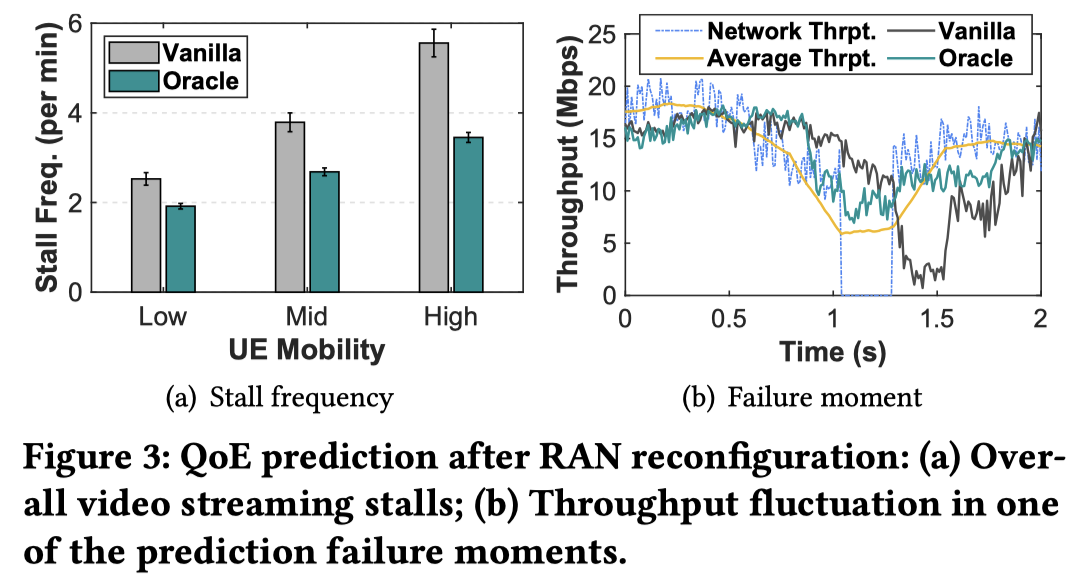
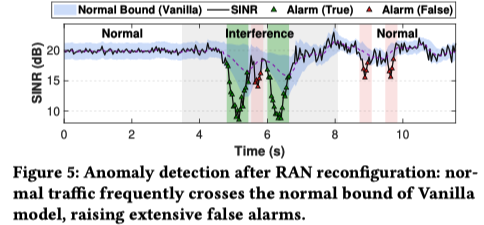
The promising AI functionalities in O-RAN expose a brittle truth when confronted with flexible reconfigurability: today’s AI models in O-RAN systems often break even under planned network upgrades. For example, an AI model trained on last month’s network data may struggle with this month’s new configuration or tuned parameters, often yielding dramatic performance degradations, following planned upgrades. Such network reconfigurations or upgrades are necessary in routine operations and essential for AI innovations. For example, network operators need to regularly modify hardware and software components, upgrade radio units, change network policies, tune AI models, etc. In practice, however, such necessary changes can invalidate previously well-trained AI models. Our measurements on a live 5G O-RAN testbed underscore the severity of this problem (§3.2). After a common cell-addition, a pretrained Quality of Experience (QoE) predictor fails to anticipate sharp throughput fluctuations, causing video streaming to suffer from a high frequency of playback stalls (Figure 3). Simultaneously, an anomaly detector is flooded with false alarms, misclassifying benign inter-cell interference from the new cell as a malicious event (Figure 5).
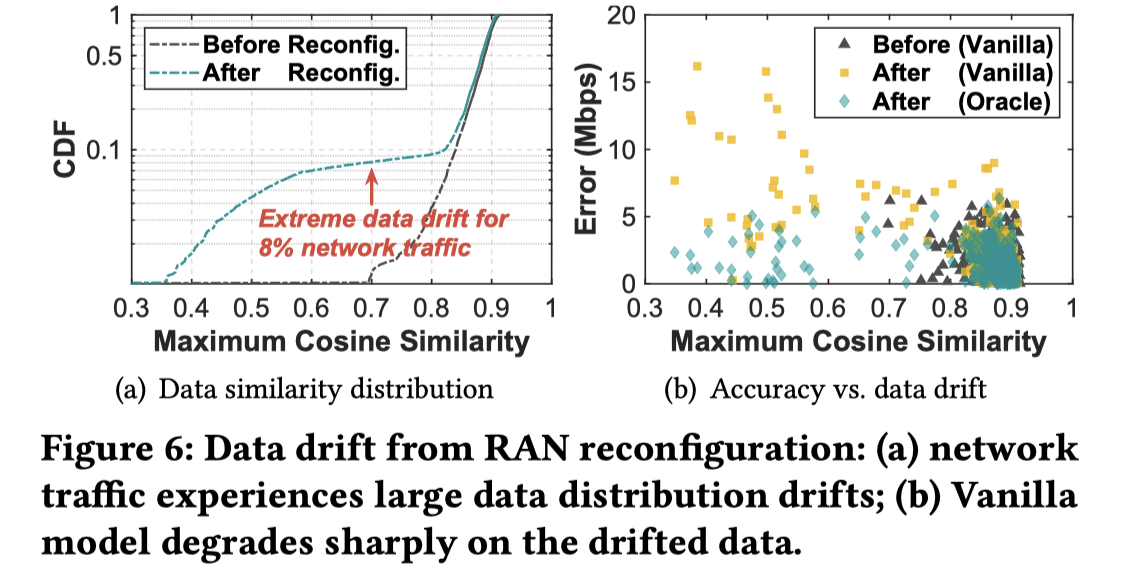
The culprit is dramatic data drift caused by network reconfigurations and component upgrades: the reconfiguration introduces novel RAN interactions and traffic dynamics that the AI model was never trained on. We quantify this drift, finding that while most traffic patterns remain similar, a critical 8% of post-reconfiguration traffic shows a significant deviation (maximum cosine similarity < 0.7) from the original training data (Figure 6). The model’s performance collapses precisely on this drifted data, with the QoE predictor’s error spiking above 10 Mbps, demonstrating that the AI model fails at the most critical moments when it must understand the network’s new operational logic.
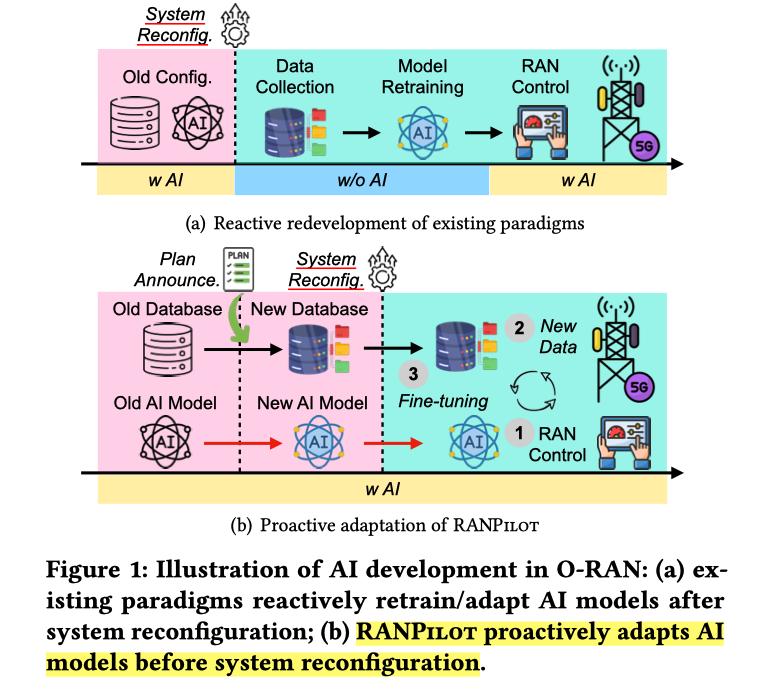
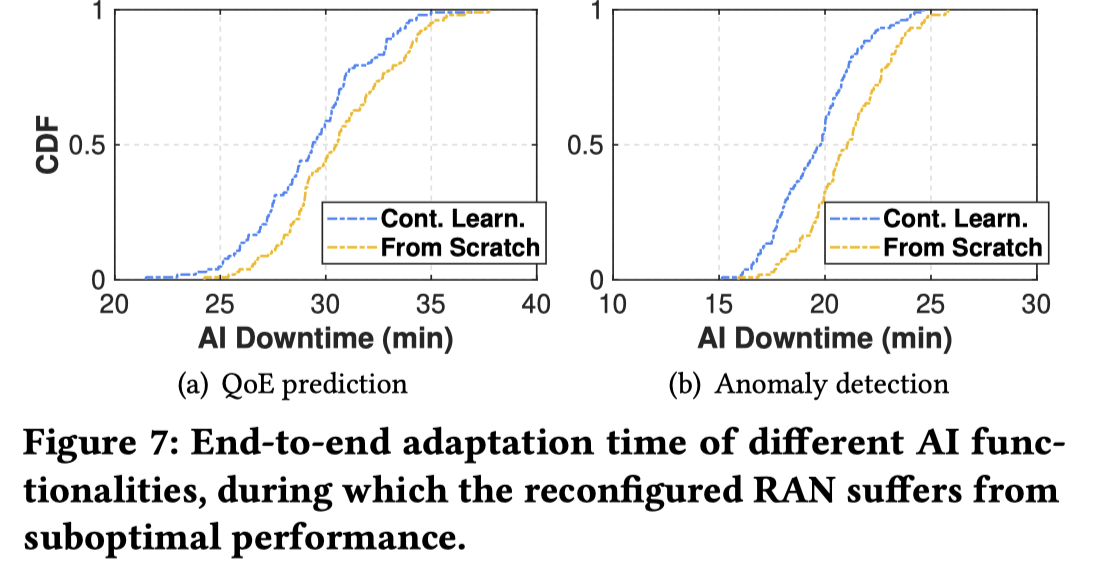
Existing solutions (e.g., reactively collecting new data to perform model adaptation after deployment as illustrated in Figure 1(a)) are agonizingly slow and operationally untenable for cellular networks. Our measurements show that adapting a QoE prediction model via continuous learning takes 29 minutes to regain its original performance, while an anomaly detection model requires 20 minutes (Figure 7). It took almost the same amount of time to train new models from scratch (31 and 21 minutes, respectively), indicating the data drift is too severe for simple fine-tuning. This prolonged period of suboptimal performance (effectively AI outage) negates the core O-RAN promise of agility and flexibility: If every dynamic upgrade incurs a half-hour of degraded service and potential user complaints, the flexibility comes at too high a cost, rendering cellular operators reluctant to adopt AI models or deliver new AI functionalities via system upgrades.
Instead of reactively fixing AI after major network reconfigurations or upgrades, can AI plan for such changes and adapt beforehand? We present RANPilot, a new framework for proactive O-RAN AI adaptation (Figure 1(b)). Its design rests on three pillars (§4): (1) At its core, RANPilot builds a lightweight virtual O-RAN that emulates the planned network changes with sufficient fidelity to synthesize training data for the future scenarios ahead of time. This differs from a heavyweight, ray-tracing-based physicallayer reconstruction [33, 70]. Instead, RANPilot targets data- and control-level fidelity by focusing on the structural network behaviors and RAN unit interactions that drive post-reconfiguration data drift. (2) RANPilot uses a dedicated meta-learning strategy to intelligently augment the synthetic KPM data that helps the model generalize to diverse operational conditions; (3) RANPilot rapidly closes the remaining simulation-to-reality gap by prioritizing important real-world KPMs for incremental tuning.
Our extensive evaluation on a live 5G O-RAN testbed [78] shows that RANPilot achieves near interruption-free AI services through reconfigurations, reducing AI downtime by 85–94% compared to reactive retraining baselines. This transforms the adaptation process from a lengthy recovery into a swift, final calibration. For instance, RANPilot prepares anomaly detection models that are ready in just 1.3–2.4 minutes and a resource allocation model that achieves near-Oracle performance immediately, resolving minor discrepancies within four minutes of deployment. From the moment of deployment, RANPilot-prepared models operate at full accuracy; our anomaly detector achieves 89.1–97.5% accuracy from the start, while the Vanilla model languishes at 30–50%. This is made possible as our synthesized data faithfully reproduces critical network dynamics of the new interaction patterns among reconfigured RAN units, such as throughput fluctuations, that are essential for robust AI but overlooked by benchmarks. By enabling AI to evolve in lockstep with network updates, RANPilot closes a critical gap in today’s O-RAN architecture. In summary, this paper makes the following contributions:
• For the first time, we draw attention to the problem of AI robustness in dynamic O-RAN reconfigurations, identifying its unique challenges and implications (§3).
• We propose RANPilot, a new framework that supports the evolution of AI functionalities prior to physical RAN reconfiguration. RANPilot marks a paradigm shift from reactive remedy to proactive adaptation for AI functionalities in reconfigurable O-RAN (§4).
• We design, implement, and evaluate RANPilot on a realistic 5G RAN testbed across various use cases. Results indicate that RANPilot can deliver performant and robust AI functionalities and support diverse applications (§5-§6).
Ethics: This work does not raise any ethical issues.
-
O-RAN的潜力与AI的脆弱性
- O-RAN架构带来了前所未有的网络重构灵活性和AI驱动的管理能力
- 然而,当前的AI模型面对网络重构时非常脆弱:
- 例如在添加新小区后,QoE(体验质量)预测模型会失效并导致视频播放卡顿(如 Figure 3 所示)
- 同时, 异常检测模型会将正常干扰误判为恶意事件并产生大量误报(如 Figure 5 所示)
-
性能崩溃的根源:数据漂移
- 网络重构和升级引入了AI模型从未见过的新网络交互和流量动态
- 发现: 重构后有8%的关键流量与原始训练数据存在显著偏差(如 Figure 6 所示)
- 而AI模型的性能崩溃恰好就发生在这部分发生“数据漂移”的关键数据上
- 网络重构和升级引入了AI模型从未见过的新网络交互和流量动态
-
现有“被动式”方案的局限性
- 现有的标准解决方案是: 在网络重构后“被动地”收集新数据来微调模型(如 Figure 1(a) 所示)
- 这种方法极度缓慢,模型恢复原有性能需要耗费20到29分钟(如 Figure 7 所示),几乎等同于从头训练模型
- 这种长时间的AI服务停机会抹杀O-RAN灵活性的优势
-
创新型解决方案:RANPILOT 框架
- 为了打破这一困境,作者提出了RANPILOT框架,将应对策略从“被动补救”转变为“主动适应”(如 Figure 1(b) 所示)
- 该框架基于三大支柱:
- 构建轻量级的“虚拟O-RAN”,在物理重构发生前合成具有高保真度的目标状态训练数据
- 利用元学习(meta-learning)策略智能增强合成数据,帮助模型适应多变的运行条件
- 通过对真实KPM(关键性能指标)进行增量微调,快速弥合仿真与现实之间的微小差距
-
显著的实验成效与贡献
- 在真实5G测试台上的评估表明,RANPILOT实现了几乎无中断的AI服务,与被动重新训练基线相比,AI停机时间大幅减少了85%至94%
- 模型在部署瞬间即可满负荷、高精度运行,成功填补了现今O-RAN架构中的一项关键空白
Related Work¶
AI functionalities in O-RAN. AI for cellular networks has gained substantial attention in recent years [11, 58, 62, 76, 93]. The rise of open and programmable control in O-RAN has further accelerated this trend, enabling developers to integrate AI/ML-driven mechanisms into the RAN for tasks such as network slicing [12, 15, 18], traffic steering [42, 66], interference mitigation [40, 94], anomaly detection [65, 80, 88, 89], and automated control [3, 23, 31, 36, 51]. The AI functionalities have been undeniably promising for smarter, more adaptive NextG cellular networks [4, 38].
Service degradation after RAN reconfigurations. Early measurement studies of large operational networks [46, 53, 54, 56] revealed that configuration changes can induce subtle yet persistent performance degradations. To reduce user-visible impact, previous work focused on minimizing service disruption through carefully coordinated, network-wide upgrades [73, 91]. More recent efforts have further enhanced system robustness and achieve near–zero downtime during network updates [39, 45, 74, 90].
With the emergence of O-RAN, however, AI-driven control and optimization have become integral to RAN operation, introducing a new vulnerability: learned models themselves can degrade under frequent and flexible reconfigurations. Existing AI functionalities remain largely rigid and tightly coupled to static configurations, making them particularly sensitive to configuration shifts [9].
AI robustness against data drift. Prior work [7] and our measurements (§3.2) show that O-RAN reconfigurations can induce severe data drift that quickly invalidates deployed AI models. The standard remedy is to adapt models to new data distributions through continuous or transfer learning [14, 37, 85, 87], and recent studies have attempted to apply these techniques to cellular systems [13, 61, 63]. However, unlike conventional AI settings, cellular networks face a practical challenge: collecting real-world data is slow, resource-intensive, and often requires lengthy over-the-air measurements [9]. Motivated by recent advances in synthetic data generation [17, 20, 29, 64, 70], we explore whether AI models can learn ahead of time using synthetic traces tailored to emulate upcoming network reconfiguration, thereby improving robustness under dynamic O-RAN reconfigurations.
AI-based network management and model adaptation. Networking systems adopt AI for network management and model adaptation across diverse domains. In wide-area networks, AIdriven traffic engineering [6, 69] aims to enhance resilience under dynamic traffic demands and topologies. In data center networks, xWeaver [86] leverages AI to adapt topology decisions to evolving traffic patterns. Similarly, cellular networks increasingly rely on AI models to execute complex operational tasks [80, 93]. However, AI in production networks suffers from severe performance degradation under planned or unplanned system changes, calling for efficient model adaptation mechanisms [50]. To tackle this degradation, LEAF [49] characterizes concept drift in large-scale cellular infrastructure and mitigates accuracy drops through a combination of targeted retraining, data forgetting, and sample oversampling. Argus [92] continuously monitors service anomalies and adapts AI models on the fly to absorb data distribution variations. Unlike these works, RANPilot specifically addresses data drift in dynamic O-RAN reconfigurations and proposes a proactive paradigm that adapts AI models using synthetic data.
-
O-RAN中的AI功能应用
- O-RAN的开放性和可编程控制特性,极大地推动了人工智能和机器学习机制在蜂窝网络中的应用
- 这些技术被广泛应用于 网络切片、流量调度、干扰缓解和自动控制 等任务,为更智能的下一代蜂窝网络带来了广阔前景
-
网络重构导致的服务降级
- 早期的网络研究, 致力于通过 "精心协调的全网升级" 来最小化服务中断,以实现近乎零停机时间的更新
- 但在O-RAN时代: 高度依赖静态配置的AI模型成为了新的脆弱点,它们在面对频繁且灵活的网络重构时极易发生性能退化
-
对抗数据漂移的AI鲁棒性
- O-RAN重构会引发严重的数据漂移,从而导致已部署的AI模型失效
- 传统的连续学习或迁移学习方案, 需要耗时且昂贵的真实数据收集过程,不适用于蜂窝网络的实际场景
- 这启发了本文: 利用"合成数据生成"技术,让AI模型在物理重构发生前进行“提前学习”. 以提升其鲁棒性
-
基于AI的网络管理与模型自适应
- 广域网和数据中心等领域, 已广泛采用AI进行拓扑适应和流量工程
- 尽管已有如LEAF和Argus等工作尝试通过目标重训、样本过采样或实时异常监控来缓解蜂窝网络中的概念漂移和性能下降
- 但 RANPilot 与它们的根本区别在于: RANPilot专门针对动态O-RAN重构,并首创性地提出了一种使用合成数据来主动自适应AI模型的全新范式
积累: 最小化断网时间
- Mubashir Adnan Qureshi, Ajay Mahimkar, Lili Qiu, Zihui Ge, Max Zhang, and Ioannis Broustis. 2017. Coordinating rolling software upgrades for cellular networks. In 2017 IEEE 25th International Conference on Network Protocols (ICNP). IEEE, 1–10.
- Ganesh Ananthanarayanan, Matthew Balkwill, Xenofon Foukas, Zhihua Lai, Bozidar Radunovic, Connor Settle, and Yongguang Zhang. 2025. Distributed AI Platform for the 6G RAN. In Proceedings of the 2nd ACM Workshop on Open and AI RAN. 15–21.
- Xin Zhe Khooi, Anuj Kalia, and Mun Choon Chan. 2025. How to Update Your 5G vRAN. In Proceedings of the 31st Annual International Conference on Mobile Computing and Networking. 123–138.
- Nikita Lazarev, Tao Ji, Anuj Kalia, Daehyeok Kim, Ilias Marinos, Francis Y Yan, Christina Delimitrou, Zhiru Zhang, and Aditya Akella. 2023. Resilient baseband processing in virtualized rans with slingshot. In Proceedings of the ACM SIGCOMM 2023 Conference. 654–667.
- Shunmugapriya Ramanathan, Koteswararao Kondepu, and Andrea Fumagalli. 2022. Resiliency in Open-Source Solutions for Disaggregated 5G Cloud Radio Access and Transport Networks. In 2022 IEEE Conference on Network Function Virtualization and Software Defined Networks (NFV-SDN). IEEE, 124–129.
- Jiarong Xing, Junzhi Gong, Xenofon Foukas, Anuj Kalia, Daehyeok Kim, and Manikanta Kotaru. 2023. Enabling resilience in virtualized rans with atlas. In Proceedings of the 29th Annual International Conference on Mobile Computing and Networking. 1–15.
- Xing Xu, Ioannis Broustis, Zihui Ge, Ramesh Govindan, Ajay Mahimkar, NK Shankaranarayanan, and Jia Wang. 2015. Magus: Minimizing cellular service disruption during network upgrades. In Proceedings of the 11th ACM Conference on Emerging Networking Experiments and Technologies. 1–13.
积累: data generation 技术用于蜂窝网络
- Xingyu Chen and Xinyu Zhang. 2023. Rf genesis: Zero-shot generalization of mmwave sensing through simulation-based data synthesis and generative diffusion models. In Proceedings of the 21st ACM Conference on Embedded Networked Sensor Systems. 28–42.
- Guoxuan Chi, Zheng Yang, Chenshu Wu, Jingao Xu, Yuchong Gao, Yunhao Liu, and Tony Xiao Han. 2024. RF-diffusion: Radio signal generation via timefrequency diffusion. In Proceedings of the 30th Annual International Conference on Mobile Computing and Networking. 77–92.
- Chen Gong, Bo Liang, Wei Gao, and Chenren Xu. 2025. Data Can Speak for Itself: Quality-guided Utilization of Wireless Synthetic Data. In Proceedings of the 23rd Annual International Conference on Mobile Systems, Applications and Services. 209–222.
- Chen Gong, Bo Liang, Wei Gao, and Chenren Xu. 2025. Data Can Speak for Itself: Quality-guided Utilization of Wireless Synthetic Data. In Proceedings of the 23rd Annual International Conference on Mobile Systems, Applications and Services. 209–222.
Background and Motivation¶
3.1 O-RAN and AI Functionalities¶
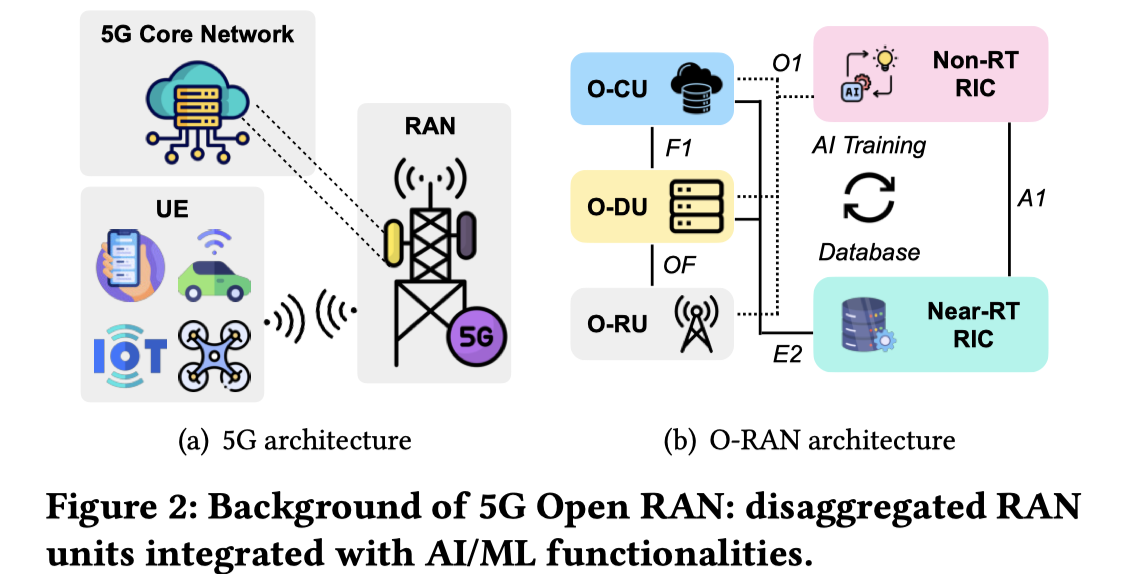
5G Networks. As illustrated in Figure 2(a), 5G networks consist of three primary components. User Equipment (UE) includes devices such as smartphones, IoT devices, and connected vehicles that access the network. Radio Access Network (RAN) provides wireless connectivity, enabling communication between UEs and the network infrastructure. 5G Core Network (5GC) manages essential functions like user authentication and mobility management, while also routing user data between the RAN and backhaul networks.
O-RAN vs. Traditional RAN. By decoupling traditional RAN hardware and standardizing interfaces, O-RAN fosters a multi-vendor ecosystem that promotes reconfigurability and innovation. As illustrated in Figure 2(b), O-RAN disaggregates RAN functions into three logical components: O-Radio Unit (O-RU), O-Distributed Unit (O-DU), and O-Central Unit (O-CU). O-RU transmits and receives radio signals over the air interface, and implements lower PHY functions (e.g., FFT/iFFT). O-DU executes higher PHY functions (e.g., scrambling, modulation), MAC scheduling, and RLC operations. O-CU handles higher-layer functions (e.g., RRC signaling, mobility management, and PDCP processing). It orchestrates UE behavior, manages handovers, and enforces QoS policies. O-RAN further integrates RAN Intelligent Controller (RIC) to coordinate AI functionalities. O-RAN collects and stores the Key Performance Metrics (KPMs) of RAN components.
Need for robust and interruption-free AI services. AI services are fundamental to network control and optimization. The flexible reconfigurability and stringent downtime requirements [45, 73] pose an urgent demand for robust and interruption-free AI functionalities, particularly during the initial phase following RAN reconfiguration. In other words, AI functionalities are expected to maintain consistent performance with ideally zero service downtime after major reconfiguration as well as system upgrades.
- 5G网络基础架构:
- 传统的5G网络主要由用户设备(UE)、无线接入网(RAN)和5G核心网(5GC)三大核心部分组成
- 如 Figure 2(a) 所示
- O-RAN的解耦与创新:
- 与传统RAN相比,O-RAN通过硬件解耦和接口标准化,将基站功能拆分为三个逻辑组件:
- O-RU: 负责底层物理层 (Low PHY)
- O-DU: 负责高层物理层与MAC/RLC层等 (High PHY / MAC / RLC)
- O-CU: 负责高层控制与策略执行 (RRC / MM / PDCP)
- 此外,O-RAN引入了RIC(RAN Intelligent Controller)来专门协调和部署AI功能
- 如 Figure 2(b) 所示
- 与传统RAN相比,O-RAN通过硬件解耦和接口标准化,将基站功能拆分为三个逻辑组件:
- AI服务的核心需求:
- O-RAN的灵活性和对停机时间的严格限制,迫切要求AI功能在经历网络重构或系统升级后,能够保持高度的鲁棒性
- 理想状态下需实现 "zero downtime" (零宕机时间)
3.2 RAN Reconfiguration and Data Drift¶
To demonstrate the fragility of current AI approach and trained models even facing planned reconfiguration and system upgrades, we conduct a series of preliminary studies (§5-§6). We measure the performance degradation of AI functionalities following routine reconfiguration operations and updates. We test two standard AI functionalities with representative model architectures and training methods:
-
QoE prediction and serving [93] predict QoE based on historical traffic patterns. Accurate predictions enable real-time, proactive adjustment of application and network parameters to maintain high user satisfaction, which is especially critical for latency-sensitive and immersive applications like AR/VR and cloud gaming [8, 19, 34, 59, 60].
-
Anomaly detection and localization [80] adopt a distribution learning model to analyze RAN KPMs to detect system failures and irregularities. Accurate and timely detections enable automated maintenance workflows and rapid recovery from network anomalies, thereby reducing operating expenses and enhancing reliability [44, 88, 89].
We tested various system reconfigurations including both hardware and software changes and upgrades. To make our discussion concrete, we start with one routine system upgrade, i.e., adding a cell tower for better coverage.
AI Service Interruption after Routine Updates. After a reconfiguration, video streaming quality degrades significantly when managed by the Vanilla QoE predictor (i.e., model before reconfiguration), exhibiting a high frequency of playback stalls that worsen with UE mobility, as shown in Figure 3(a). The root cause is that the current AI approach does not train the model to cope with the sharp data drift caused by major network reconfiguration. As a result, the Vanilla model lags behind the actual throughput as shown in Figure 3(b), leading to performance degradation and affect user experience.
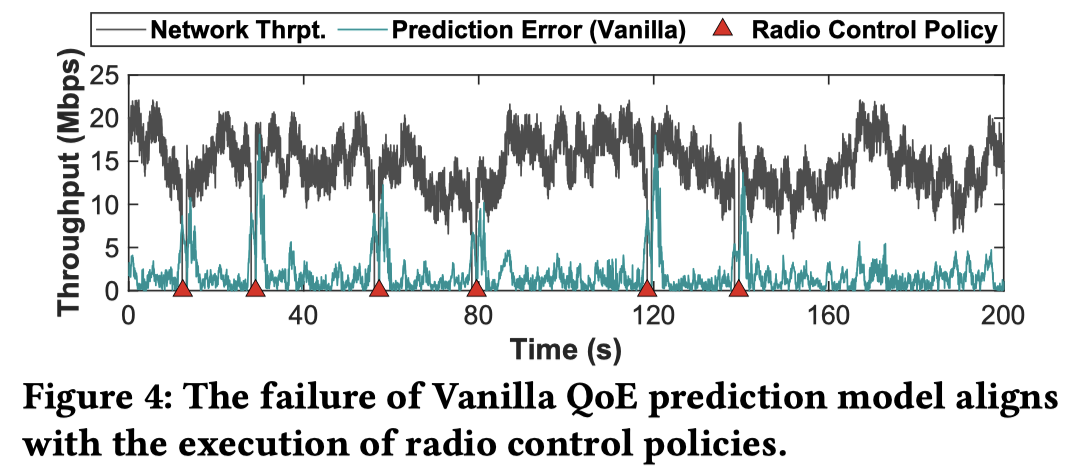
By cross-checking these failures with RAN operation logs, we discovered a notable pattern: the most failures for the Vanilla model coincide with the updates to radio control policies, as shown in Figure 4. These newly integrated policies (e.g., possible handover to/from the new RAN unit) cause network dynamics that were unseen by the Vanilla model, rendering the model ineffective.
Our measurements on anomaly detection unveil similar limitations of current AI approach and trained models. Figure 5 illustrates that following a system reconfiguration, the Vanilla anomaly detection model frequently misclassifies benign network behavior (e.g., new patterns of inter-cell interference) as malicious anomalies. These subtle fluctuations are typically caused by the reconfigured topology but rarely seen in the collected data.
In both cases, we observe that the AI models cannot stay effective and robust throughout major reconfigurations and system upgrades.
Impact of RAN Reconfiguration on Data Distribution. We further analyze the data distribution variation of network traffic induced by RAN reconfiguration. To quantify data distribution variations, we adopt a unique metric, maximum cosine similarity, which assesses the affinity of each new KPM sample to the training set used by the Vanilla model. Specifically, for each new KPM sample, we compute its cosine similarity with all training samples and select the maximum value as a proxy, representing the closest distance between the KPM sample and the training set [77]. This approach can eliminate the influence of the inherently high variance of cellular traffic. To benchmark the impact of reconfiguration, we measure two 20-minute traffic segments: one before and one after the reconfiguration. We segment each trace into 2 s intervals and compute their similarities to the training set.
Our empirical analysis shows that, although overall data similarity remains broadly stable after reconfiguration, a notable portion of network traffic diverges significantly from the training distribution (see Figure 6(a)). These low-similarity segments are unrepresented in the original training set and invalidate the Vanilla model. As illustrated in Figure 6(b), throughput predictions become highly unreliable in these low-affinity regions. These results indicate that RAN reconfigurations introduce substantial data drift, undermining the robustness of pretrained, static O-RAN AI models.
Limitations of Existing Solutions. Data drift is a well-known challenge in AI. Moderate data drift can be addressed by continuous learning [14, 37, 85, 87]. However, this reactive approach is untenable in O-RAN due to two unique challenges: 1) Lack of post-reconfiguration data. Adapting AI models requires collecting new training data in target domains (i.e., after reconfiguration), which is unavailable until the reconfiguration is enforced. 2) Stringent downtime requirement. Cellular networks impose a stringent service downtime requirement [45, 73]. Continuous learning [85] generally takes a long time to collect sufficient post-reconfiguration data for fine-tuning models. During this process, the AI models inevitably suffer from drastic performance degradation, rendering cellular operators reluctant to adopt AI models or deliver new AI functionalities via system upgrades.
To quantify the reconfiguration tax, we measure the time required to adapt the models. Specifically, we consider two adaptation approaches: 1) updating the Vanilla models via continuous learning [82], and 2) collecting new KPM traces after reconfiguration and training new models from scratch. We measure the AI downtime, which is defined as the duration from the activation of RAN reconfiguration till the adapted AI model achieves 95% of its best performance (denoted as Oracle). The two models require 29 and 20 minutes for continuous learning, respectively (Figure 7). Notably, due to the time-consuming data collection and continuous learning required to handle extreme data drift, the adaptation efforts are almost the same as developing a new model from scratch, which takes about 31 and 21 minutes, respectively. These adaptation methods lead to extended AI service downtime and prolonged periods of suboptimal network performance, negating O-RAN’s flexible reconfigurability.
In summary, we have two key observations:
- Major reconfiguration and system upgrades introduce extreme data drift, obsoleting AI functionalities developed on legacy data.
-
Existing continuous learning or fine-tuning solutions lead to unacceptable service downtime with performance degradation.
-
重构导致AI服务严重中断:
- 初步研究表明,即使是计划内的常规升级(如添加新基站),也会导致原有AI模型失效
- 例如,QoE预测模型无法适应新的吞吐量波动,导致视频流频繁卡顿(如 Figure 3(a) 和 Figure 3(b) 所示)
- 异常检测模型则会将新小区带来的正常干扰误判为恶意攻击,产生大量误报(如 Figure 5 所示)
-
控制策略变更是失效诱因:
- 通过交叉比对运行日志,作者发现: 原始(Vanilla)模型的大量预测失败时刻,与无线电控制策略(Radio control policy)的更新执行时刻高度吻合
- 如 Figure 4 所示:
-
量化“数据漂移”的破坏力:
- 系统重构会引发极端的 "data drift"
- 通过计算最大余弦相似度发现,重构后有约8%的关键网络流量与原训练数据存在严重偏差(相似度 < 0.7,如 Figure 6(a) 所示)
- 而AI模型恰好在这些偏离的特征区域出现了性能的完全崩溃(如 Figure 6(b) 所示)
-
现有自适应方案存在致命局限:
- 传统的连续学习(Continuous learning)方案属于“被动补救”,必须等待重构完成后收集新数据才能进行微调
- 实测显示,模型重新适应需要耗费 20 到 29 分钟,这几乎与从头训练新模型(21 到 31 分钟)所花费的时间一样长(如 Figure 7 所示)
- 这种漫长的服务降级时间彻底抵消了O-RAN本该带来的敏捷性优势
RANPILOT Design¶
4.1 System Overview¶
Is it possible to develop robust AI models that can look ahead and accommodate RAN system reconfiguration without service interruption? A fundamental obstacle is that AI adaptation requires training data, yet real post-reconfiguration data is unavailable prior to deployment, and collecting it afterward is prohibitively slow. To address this gap, we propose RANPilot, a novel framework that proactively adapts AI models ahead of RAN reconfigurations using synthetic data. By enabling AI adaptation before reconfiguration, RANPilot mitigates the data drift that could break the deployed models during major system upgrades.
However, effective data synthesis and AI adaptation for dynamic O-RAN reconfigurations face three key challenges: (i) Capturing System Changes. O-RAN introduces disaggregated units and programmable control policies with highly flexible and dynamic reconfigurations. These changes alter traffic patterns and even system topology, making it difficult to synthesize data that faithfully reflects underlying network behaviors. (ii) Ensuring Data Generalization for AI Robustness. To adapt the AI models with sufficient robustness, synthetic data must comprehensively cover diverse operational scenarios and network dynamics. (iii) Bridging the Reality Gap. Even the best synthetic data cannot fully replicate real-world nuances such as environmental dynamics. Thus, post-reconfiguration, we must efficiently use real data to close this gap as quickly as possible.
Figure 8 illustrates the overview of RANPilot. To faithfully emulate O-RAN reconfigurations, RANPilot builds a virtual ORAN that abstracts disaggregated RAN units, their interactions, and control policies (§4.2). Driven by real network traces and expert knowledge, this virtual O-RAN emulates diverse reconfiguration changes while preserving essential system behaviors. To improve the AI robustness, RANPilot augments the synthesized data from virtual O-RAN with rich operational scenarios and network dynamics (§4.3). A modified meta-learning module [22] learns how to augment O-RAN KPM traces and continuously incorporates synthesized data from unseen configurations into a local database, enabling progressive refinement and improved generalization. Finally, to rapidly close the simulation-to-reality gap after deployment, RANPilot detects biased traffic patterns and assigns priority weights for selective replay, enabling efficient incremental training using real KPM data (§4.4). When operators plan an O-RAN reconfiguration, they notify RANPilot of the target RAN configuration and desired AI functionalities via RAN and AI APIs; RANPilot then synthesizes and augments KPM data to adapt the AI models, which are subsequently refined online after deployment to ensure accuracy under live network conditions.
TL; DR:
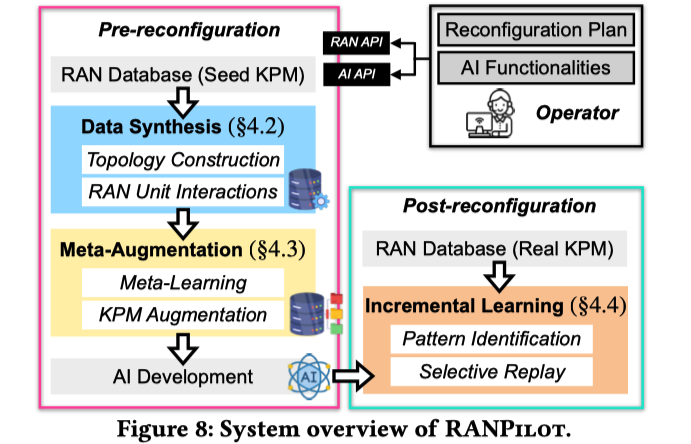
- RANPILOT 旨在通过合成数据,在物理网络重构发生前主动自适应 AI 模型,从而缓解导致模型失效的数据漂移问题
- 整个系统的完整工作流包含三大核心模块:
- 构建 virtual O-RAN 模拟重构
- 利用元学习增强数据以提升模型泛化能力
- 在部署后利用增量学习, 快速弥合仿真与真实环境之间的差距
4.2 Building Virtual O-RAN¶
4.2.1 Insight & Solution. Proactive AI adaptation requires future state data before a physical reconfiguration occurs. To synthesize effective data for AI adaptation, our design is grounded on three core principles: (1) Data and control fidelity over PHY exactness. Instead of simulating every waveform, we abstract radio units and model their interactions at the control and scheduling layers. This captures the system-level variations that dominate KPM drift and AI performance. (2) Interface- and policy-awareness. We explicitly emulate open interfaces and their contention dynamics, along with operator-defined radio control policies. (3) Trace-driven realism. We bootstrap the synthesis with real KPM traces from the current RAN, then perturb them to reflect new topology, mobility, and interference. As illustrated in Figure 9, our design follows three stages: building a static skeleton of the target O-RAN configuration, generating O-RAN traffic, and synthesizing O-RAN unit interactions. The result is a lightweight virtual O-RAN – a trace-driven emulator that generates post-reconfiguration KPM data for downstream AI adaptation. It departs from PHY-exact digital twins [33, 70], and instead captures system-level variations that ultimately reshape KPM traces after reconfiguration.
4.2.1 见解与解决方案
主动式 AI 自适应要求在物理重构发生之前获取未来状态的数据。为了合成用于 AI 自适应的有效数据,我们的设计基于三大核心原则:
(1)数据与控制保真度优于物理层(PHY)精确度。我们并未模拟每一个波形,而是对无线电单元进行抽象,并在控制层与调度层对其交互进行建模。此方法能够捕捉主导 KPM(关键性能指标)漂移与 AI 性能的系统级变化
(2)接口与策略感知。我们显式地仿真了开放接口及其竞争动态,以及运营商定义的无线电控制策略
(3)轨迹驱动的真实性。我们利用当前 RAN(无线接入网)的真实 KPM 轨迹来引导数据合成,随后对其进行扰动,以反映新的拓扑结构、移动性与干扰情况
如图 9 所示,我们的设计分为三个阶段:构建目标 O-RAN 配置的静态骨架、生成 O-RAN 流量以及合成 O-RAN 单元交互
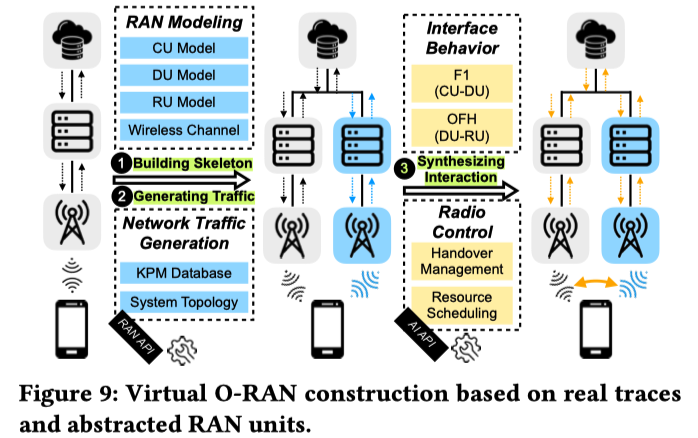
最终成果是一个轻量级虚拟 O-RAN——一个由轨迹驱动的仿真器,能够为下游的 AI 自适应生成重构后的 KPM 数据。它有别于追求物理层精确的数字孪生 [33, 70],而是侧重于捕捉最终在重构后重塑 KPM 轨迹的系统级变化
4.2.2 Workflow & Input/Output Schema. The virtual O-RAN is a trace-driven emulator built from softwarized RAN units. It takes seed KPM traces as input and allows planned reconfigurations to be applied to the software units. In addition, we explicitly model external factors that affect KPM distribution (e.g., RU placement, wireless channel, O-RAN interface contention) to align the emulator with real-world physical variations. The following control knobs support diverse RAN reconfigurations (detailed in Table 4): (1) Topology, which represents the target O-RAN as a directed graph. The nodes consist of abstracted CU, DU, and RU, while the edges represent the F1 (CU–DU) and Open Fronthaul (DU–RU) interfaces. The adjacency encodes hierarchy and enables per-interface latency/bandwidth effects to propagate into synthesized KPMs; (2) Cell configuration, which defines cell identities and adjacent cell topologies used for tracking handovers; (3) RAN unit configuration, which modifies softwarized RAN (RU, DU, CU) variables; (4) xApp, which executes programmable control logic. For example, cell addition can be emulated by changing the topology, cell configurations, and RU variables; PRB scheduling or handover policy upgrades can be emulated by modifying specific control logic in the xApp and DU/CU variables.
4.2.2 工作流与输入/输出模式
虚拟 O-RAN 是一个基于软件化 RAN 单元构建的轨迹驱动仿真器。它以种子 KPM 轨迹作为输入,并允许将计划中的重构应用于这些软件单元。
此外,我们显式地对影响 KPM 分布的外部因素(例如,RU 部署位置、无线信道、O-RAN 接口竞争)进行了建模,以使仿真器与真实世界的物理变化保持一致。
以下控制旋钮支持多种 RAN 重构(详见表 4):
- 拓扑(Topology),将目标 O-RAN 表示为有向图
- 节点由抽象的 CU、DU 和 RU 组成,而边代表 F1(CU-DU)和开放前传(Open Fronthaul, DU-RU)接口
- 邻接关系编码了层级结构,并允许单接口的延迟/带宽效应传播至合成的 KPM 中
- 小区配置(Cell configuration),定义小区标识以及用于跟踪切换(handover)的相邻小区拓扑
- RAN 单元配置(RAN unit configuration),用于修改软件化 RAN(RU、DU、CU)的变量
- xApp,负责执行可编程控制逻辑
- 例如,可以通过改变拓扑、小区配置和 RU 变量来仿真小区添加
- 可以通过修改 xApp 和 DU/CU 变量中的特定控制逻辑来仿真 PRB 调度或切换策略的升级
4.2.3 Building O-RAN Skeleton. To emulate a reconfigured O-RAN system, we first build its structural skeleton by initializing software RAN units at each layer within the input RAN topology. Rather than modeling the full protocol stack, we utilize functional abstractions that capture the essential RAN unit behaviors that drive KPM drift. In our design, RU represents a lightweight PHY-layer abstraction, handling signal propagation by executing commands from the upper layer and reporting PHY KPMs; DU serves as a control and buffering entity, and its functions include aggregating metrics from lower layers and performing basic scheduling; CU operates as a policy-driven controller, tasked with managing UE state and enforcing radio resource control. This layered skeleton (❶ in Figure 9) allows flexible construction of a target O-RAN system with various radio unit abstractions forming different topologies.
4.2.3 构建 O-RAN 骨架
为了仿真重构后的 O-RAN 系统,我们首先通过 在输入 RAN 拓扑的各个层级初始化软件 RAN 单元来构建其结构骨架
我们并未对完整的协议栈进行建模,而是利用功能抽象来捕捉驱动 KPM 漂移的核心 RAN 单元行为。
在我们的设计中:
- RU 代表一种轻量级的物理层抽象: 通过执行来自上层的命令并报告物理层 KPM 来处理信号传播
- DU 充当控制与缓冲实体: 其功能包括聚合来自底层的指标并执行基础调度
- CU 作为策略驱动的控制器运行: 任务是管理 UE 状态并执行无线电资源控制
这种分层骨架(图 9 中的 ❶)允许灵活构建由各种无线电单元抽象形成不同拓扑的目标 O-RAN 系统。
4.2.4 Generating O-RAN Traffic. We then generate synthetic KPM traces that activate the static O-RAN skeleton into a live virtual system. (1) KPM-driven bootstrapping. We seed the virtual O-RAN with a KPM database that spans radio resources, UE channel quality, and QoS metrics (detailed in Table 3). The KPMs are grounded on the current real RAN operational states and provide the statistical priors for our synthesis. (2) Traffic reconstruction and generation. We generate O-RAN traffic with a bifurcated strategy. For unchanged RAN units, we directly reconstruct traffic by replaying real-world KPM traces to maintain absolute baseline fidelity. For newly added or reconfigured units, we reuse behavioral priors from real traces but adjust them based on the new topology and network dynamics. This ensures realistic physical coupling (e.g., inter-cell interference) and produces plausible KPMs that reflect the target topology. (3) PHY consistency via wireless modeling. We integrate a lightweight wireless channel model as an important external factor that links the software emulator to real-world PHY impacts of changed RUs, ensuring the generated KPMs remain physically consistent. Instead of complex ray-tracing [33], we account for both mobility-induced and stochastic channel dynamics [32]:
with path loss \(PL(d(t))\), shadowing \(X_{\sigma}\), and fading \(F(t)\); mobility and environment enter via \(d(t)\) and \(F(t)\), respectively (detailed in §A.4). To map input traces and configurations to the wireless channel model, RANPilot executes a trace-driven parameter tuning procedure: Specifically, we tune SINR parameters to match seed KPM traces, and retain SINR environment parameters for the reconfigured RU while adjusting distance/mobility parameters to simulate PHY changes. Overall, this real-KPM-driven generation (❷ in Figure 9) outputs basic synthetic KPM traces that the AI models and RAN controllers can operate on.
4.2.4 生成 O-RAN 流量
随后,我们生成合成的 KPM 轨迹,将静态的 O-RAN 骨架激活为一个实时的虚拟系统:
(1)KPM 驱动的引导(Bootstrapping)
我们利用涵盖无线电资源、UE 信道质量以及 QoS 指标(详见表 3)的 KPM 数据库作为虚拟 O-RAN 的种子。这些 KPM 基于当前真实的 RAN 运行状态,为我们的合成提供了统计先验
(2)流量重构与生成
我们采用双重策略生成 O-RAN 流量:
- 对于未改变的 RAN 单元,我们通过重放真实世界的 KPM 轨迹直接重构流量,以保持绝对的基线保真度
- 对于新增或重构的单元,我们复用真实轨迹中的行为先验,但根据新的拓扑结构和网络动态对其进行调整
这确保了符合现实的物理耦合(例如,小区间干扰),并生成反映目标拓扑的合理 KPM
(3)通过无线建模实现物理层一致性
我们将轻量级无线信道模型整合为一个重要的外部因素,将软件仿真器与更改后的 RU 对现实物理层的影响联系起来,确保生成的 KPM 保持物理上的一致性
我们并未采用复杂的射线追踪技术 [33],而是考虑了由移动性引起的以及随机的信道动态 [32]:
其中,路径损耗为 \(PL(d(t))\),阴影衰落为 \(X_{\sigma}\),快衰落为 \(F(t)\);移动性和环境因素分别通过 \(d(t)\) 和 \(F(t)\) 引入(详见 §A.4)
为了将输入轨迹和配置映射至无线信道模型,RANPilot 执行了轨迹驱动的参数调优程序:具体而言,我们对 SINR 参数进行调优以匹配种子 KPM 轨迹,并保留重构 RU 的 SINR 环境参数,同时调整距离/移动性参数以仿真物理层的变化
总体而言,这种由真实 KPM 驱动的生成过程(图 9 中的 ❷)输出了可供 AI 模型和 RAN 控制器进行操作的基础合成 KPM 轨迹
4.2.5 Synthesizing O-RAN Unit Interactions. We next synthesize the essential RAN unit interactions that reshape the network behaviors and drive data drift. (1) Open-interface behaviors. While software RAN units can be directly updated within the emulator, the open-interface behaviors that affect KPM distribution must be considered. Specifically, we integrate an Open Fronthaul (OFH) interface contention model as an important external factor that replays O-RAN interface behavior. When multiple RUs share a constrained OFH, concurrent packet arrivals can lead to collisions [48, 80]. To map input traces and configurations to the OFH contention model, we calculate the packet loss probability \(P_{loss}\) as a function of the aggregate fronthaul throughput \(S\), derived by the average throughput per RU times the number of contending RUs. As \(S\) approaches the interface capacity \(C\), the probability of collision increases: \(P_{loss}(S) = 1 - e^{-\lambda(S/C)}\). We use \(\lambda = 2\), calibrated from empirical measurements. These collisions trigger higher-layer retransmissions, which we derive into observable KPM impacts: increased latency due to backoff timers and a proportional degradation in effective UE throughput. (2) Radio control policies. O-RAN decouples control policies through programmable xApps [5, 71]. These customizable policies [1] are not mere configuration details. They act as first-order drivers of data drift during reconfigurations and reshape traffic patterns. This AI-in-the-loop emulation approach enables the model to approximate the empirical mapping between policy updates and resulting network behaviors. For AI models that do not directly affect network policies or control loops, the new models are reconfigured in virtual O-RAN for emulation and model adaptation. The interaction synthesis (❸ in Figure 9) produces essential but underrepresented network behaviors beyond the Vanilla KPM database, mitigating data drift in the post-reconfiguration state.
4.2.5 合成 O-RAN 单元交互
接下来,我们合成那些重塑网络行为并驱动数据漂移的核心 RAN 单元交互:
(1)开放接口行为
虽然软件 RAN 单元可以直接在仿真器内更新,但必须考虑影响 KPM 分布的开放接口行为。
具体而言,我们将开放前传(Open Fronthaul, OFH)接口竞争模型集成为一个重要的外部因素,用于重放 O-RAN 接口行为。
当多个 RU 共享受限的 OFH 时,并发的数据包到达会导致冲突 [48, 80]。
为了将输入轨迹和配置映射到 OFH 竞争模型中,我们将丢包率 \(P_{loss}\) 计算为聚合前传吞吐量 \(S\) 的函数,其中 \(S\) 由每个 RU 的平均吞吐量乘以产生竞争的 RU 数量得出。
当 \(S\) 接近接口容量 \(C\) 时,冲突概率增加:\(P_{loss}(S)=1-e^{-\lambda(S/C)}\)。我们使用 \(\lambda=2\),该值根据经验测量数据校准得出。
这些冲突会触发高层重传,我们将其转化为可观测的 KPM 影响:
由于退避定时器(backoff timers)导致的延迟增加,以及有效 UE 吞吐量的等比例下降。
(2)无线电控制策略
O-RAN 通过可编程的 xApp 对控制策略进行解耦 [5, 71]。这些可定制的策略 [1] 绝非简单的配置细节。它们在重构期间作为数据漂移的首要驱动力,重塑了流量模式。
这种“AI 在环(AI-in-the-loop)”的仿真方法使得模型能够逼近策略更新与由此产生的网络行为之间的经验映射。
对于不直接影响网络策略或控制环路的 AI 模型,会在虚拟 O-RAN 中对新模型进行重新配置,以进行仿真和模型自适应。这种交互合成(图 9 中的 ❸)产生了原始(Vanilla)KPM 数据库中未被充分体现的核心网络行为,从而缓解了重构后状态下的数据漂移。
TL; DR:
设计原则: virtual O-RAN 是一个轻量级仿真器. 它侧重于数据与控制层面的逻辑保真度而非物理层(PHY)的精确模拟, 并高度依赖真实的 KPM(关键性能指标)历史轨迹来驱动
三个构建阶段:
- 构建 O-RAN 骨架:
- 初始化轻量级的 CU、DU 和 RU 软件抽象单元,搭建目标拓扑结构
- 生成 O-RAN 流量:
- 利用真实的 KPM 数据库作为基础先验,并结合轻量级的无线信道模型来保证物理层一致性
- 合成 O-RAN 单元交互:
- 这是捕捉数据漂移的关键,系统会模拟开放前传(OFH)接口的拥塞竞争模型以及 xApp 定义的无线电控制策略
4.3 Harnessing Network Dynamics¶
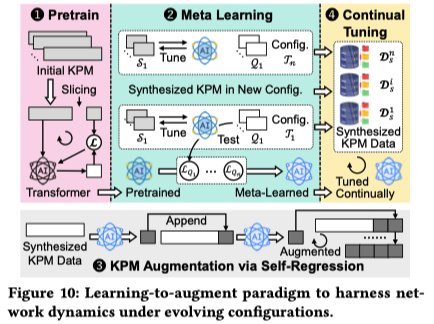
4.3.1 Insight & Solution. The virtual O-RAN can effectively generate target-state KPM traces for new RAN configurations, but network dynamics and cross-scenario variability can be under-represented. Moreover, the limited quantity of synthetic KPM traces is insufficient to train robust AI models and can lead to overfitting. To address these issues, augmenting the synthetic KPM data is a promising approach to improving both quantity and quality. Unfortunately, hand-crafted augmentation (e.g., random jittering or resampling) distorts temporal dependencies and cross-metric correlations that downstream AI relies on. To tackle this problem, we propose a continuous meta-augmentation paradigm that first teaches AI models to learn how to augment KPM data and continuously evolve by dynamically maintaining a configuration database as operators plan additional reconfigurations. Figure 10 illustrates the workflow of our continuous meta-augmentation paradigm. Given the synthetic KPM data (§ 4.2), the paradigm generates an augmented KPM dataset with enhanced quantity and quality through four steps: pretraining that captures network dynamics, meta-learning that learns how to augment, KPM augmentation, and continual tuning in response to emerging O-RAN reconfigurations. This approach captures the intricate spatio-temporal dependencies inherent in multi-dimensional KPM data.
4.3.2 Capturing Network Dynamics. We pretrain a lightweight, six-layer Transformer [84] on synthetic KPM data to serve as a foundation model. Given a KPM sample, this model can predict subsequent KPM segments, which capture diverse network dynamics that are often deeply buried within KPM data. Specifically, we first segment each KPM sample \(\mathcal{K}\) into a set of slices \(\mathcal{K}_s = \{k_1, k_2, \cdots\}\) by truncating the data at varying indices. The KPM data following each slicing point serves as the ground-truth label. We then feed \(\mathcal{K}_s\) into the model to predict the next KPM trace and train the model by minimizing the loss between the predicted KPM and the ground truth. This method has two main advantages: (1) the entire training process is autoregressive and self-supervised, eliminating the need for manual labeling; (2) by generating multiple slices from varying truncation points, the model can effectively learn diverse network dynamics even from a limited quantity of synthetic KPM data.
4.3.3 Learning to Augment. We redirect the pretrained model \(\mathcal{M}\) to learn how to augment KPM traces across diverse RAN configurations via meta-learning [22]. As new RAN configurations emerge, the synthesized KPM data is stored in a progressively updated database \(\mathcal{D}\). For each configuration \(\mathcal{T}_i\) in \(\mathcal{D}\), we split the KPM traces into a support set \(\mathcal{S}_i\) and a query set \(\mathcal{Q}_i\). We then perform a meta-update: a copy of \(\mathcal{M}\) is trained on \(\mathcal{S}_i\) and evaluated on \(\mathcal{Q}_i\). The evaluation losses across all configurations \(\{\mathcal{T}_1, \mathcal{T}_2, \cdots\}\) are summed to update the original \(\mathcal{M}\). This alternating optimization process is repeated for several epochs until \(\mathcal{M}\) converges. Such a meta-trained model \(\hat{\mathcal{M}}\) can effectively generalize its KPM augmentation capabilities across various configurations.
4.3.4 KPM Augmentation. To perform augmentation, we segment KPM traces from each configuration \(\mathcal{T}_i\) into multiple slices and leverage the meta-trained model \(\hat{\mathcal{M}}\) to generate subsequent KPM traces in an autoregressive manner (§ 4.3.2). The augmented KPM data \(\mathcal{D}^a = \{\mathcal{D}_1, \mathcal{D}_2, \cdots\}\), along with the sliced synthetic data \(\mathcal{K}_s\), are used to retrain the O-RAN AI models prior to physical RAN reconfigurations.
4.3.5 Continual Tuning. Unlike conventional meta-learning methods that rely on static datasets, we implement a dynamic, continuous meta-learning based on the progressively maintained database \(\mathcal{D}\). An intuitive approach would be to continuously fine-tune the augmentation model \(\hat{\mathcal{M}}\) using the entire \(\mathcal{D}\) as new RAN configurations arrive. Nonetheless, we observe that this strategy leads to intransigence. As the database expands, early-arriving configurations are repeatedly sampled during training, causing the model to overfit to historical data and overshadow recent samples. Consequently, the model exhibits suboptimal adaptability to new RAN configurations. To mitigate this, we adopt a linear decay weighting scheme during continual tuning. Specifically, during loss calculation, we assign a decay weight of \(1/n\) to each RAN configuration, where \(n\) represents the cumulative number of times that configuration has been used for tuning. We select a \(1/n\) decay rate, as faster-decaying functions penalize historical data too aggressively and can cause catastrophic forgetting on early RAN states. The harmonic \(1/n\) decay satisfies standard stochastic approximation conditions and allows the model to continuously adapt to emerging configurations while retaining historical network behaviors. Algorithm 1 shows the detailed process.
黑魔法. 不看了...
TL; DR:
为了解决合成 KPM 数据量有限且容易导致模型过拟合的问题,系统引入了“连续元增强(continuous meta-augmentation)”范式:
- 模型预训练:
- 使用一个轻量级的 6 层 Transformer 模型对切片后的合成 KPM 数据进行自回归预训练,以捕捉深藏的复杂网络动态
- 元学习与生成:
- 利用元学习(meta-learning)让预训练模型掌握在多变配置下增强数据的能力
- 并自动生成高质量、大规模的增强 KPM 数据集
- 连续微调 (Continual Tuning):
- 在动态维护配置数据库时,系统采用了 \(1/n\) 的线性衰减权重方案
- 既能使模型快速适应新配置,又能有效防止其遗忘早期的网络状态
4.4 Closing Simulation-to-Reality Gap¶
4.4.1 Insight & Solution. Admittedly, the virtual O-RAN and meta-augmentation may not be able to cover all possible dynamics in real diverse scenarios. The real-world nuances could arise from local implementation details, user behavior, and environmental factors that cannot be fully captured. An intuitive solution is to adopt incremental learning [57] that replays useful data to reinforce AI models. Unfortunately, traditional incremental learning cannot be applied in O-RAN because useful KPM patterns (capturing data drift) are sparse and naive replay is dominated by typical KPM patterns, which could lead to catastrophic forgetting. To remedy this, we apply a new incremental learning strategy with selective replay that detects useful, drift-carrying patterns on the fly and assigns them higher priority during incremental tuning to prevent forgetting. This allows RANPILOT to adapt to real-world data and close the simulation-to-reality gap.
4.4.1 见解与解决方案
诚然,虚拟 O-RAN 与元增强可能无法涵盖现实多样化场景中的所有可能动态。现实世界中的细微差别可能源于无法被完全捕捉的本地实现细节、用户行为以及环境因素
一种直观的解决方案是采用增量学习(incremental learning)[57],通过回放有用数据来强化 AI 模型
遗憾的是:
传统的增量学习无法应用于 O-RAN,因为有用的 KPM 模式(捕捉数据漂移的模式)非常稀疏,而朴素的数据回放会被典型的 KPM 模式所主导,这可能导致灾难性遗忘(catastrophic forgetting)
为了解决这一问题,我们应用了一种带有 选择性回放(selective replay)的新型增量学习策略
该策略能够实时检测携带有漂移信息的有用模式,并在增量微调期间赋予它们更高的优先级,以防止模型遗忘
这使得 RANPILOT 能够适应现实世界的数据,并弥合仿真与现实之间的差距
4.4.2 Module Breakdown. (1) Useful pattern identification. We first define the dominant pattern \(K_d\) as the KPM traces that produce normal inference results from O-RAN AI models (e.g., KPM that does not trigger alarms in anomaly detection). Then, we adopt a sliding window of length \(l\) to sequentially slice the incoming KPM traces. For each KPM slice, we quantify its data distribution affinity to the dominant pattern by calculating the Kullback-Leibler divergence (KLD) [47] between the two KPM traces. A larger KLD value indicates a greater disparity in data distributions between the dominant pattern and the current KPM slice. The useful pattern is then identified as the KPM slice whose KLD value exceeds a predefined threshold \(\tau\). (2) Selective replay based on weighted priority assigns different priority weights to distinct KPM slices for tuning. The underlying rationale is that, as useful patterns in incoming KPM traces typically yield higher KLD values, we assign them higher priority for incremental training, while assigning lower priority for dominant patterns. Specifically, at regular intervals, we collect \(t\) incoming KPM slices \(K_1, K_2, \cdots, K_t\). The priority weight \(p_i\) of \(K_i\) is then determined to be equal to its computed KLD value. Next, the top-\(b\) KPM slices with the highest priority are selected and stacked into a KPM buffer of size \(b\). Once the buffer is full, we incrementally train the O-RAN AI model using the priority weight of each KPM slice during loss calculation. Note that we set \(t \gg b\) to ensure that the collected KPM slices encompass a sufficient variety of traffic patterns, with the buffer containing more useful patterns than dominant patterns. As such, both types of KPM patterns will be replayed for incremental training.
4.4.2 模块分解
(1)有用模式识别
我们首先将主导模式 \(K_d\) 定义为在 O-RAN AI 模型中产生正常推理结果的 KPM 轨迹(例如,在异常检测中未触发警报的 KPM)。
然后,我们采用长度为 \(l\) 的滑动窗口对输入的 KPM 轨迹进行顺序切片。
对于每个 KPM 切片,我们通过计算两个 KPM 轨迹之间的 Kullback-Leibler 散度(KLD)[47] 来量化其与主导模式的数据分布亲和度。较大的 KLD 值表明主导模式与当前 KPM 切片之间的数据分布差异更大。随后,KLD 值超过预定义阈值 \(\tau\) 的 KPM 切片将被识别为有用模式
(2)基于加权优先级的选择性回放
为不同的 KPM 切片分配不同的优先级权重以进行微调。
其潜在的基本原理是,由于输入 KPM 轨迹中的有用模式通常会产生较高的 KLD 值,因此我们在增量训练中为其分配较高的优先级,同时为主导模式分配较低的优先级。
具体而言,我们以固定的时间间隔收集 \(t\) 个输入的 KPM 切片 \(K_1,K_2,\cdots,K_t\)。随后 \(K_i\) 的优先级权重 \(p_i\) 被设定为等于其计算出的 KLD 值。接着,选取具有最高优先级的前 \(b\)(top-\(b\))个 KPM 切片,并将其压入大小为 \(b\) 的 KPM 缓冲区中。
一旦缓冲区填满,我们便在损失计算期间利用每个 KPM 切片的优先级权重对 O-RAN AI 模型进行增量训练。
需要注意的是,我们设置 \(t\gg b\),以确保收集到的 KPM 切片包含足够多样化的流量模式,从而使缓冲区中包含的有用模式多于主导模式。因此,这两种类型的 KPM 模式都将被回放以用于增量训练。
TL; DR:
- 由于仿真无法完美复制真实世界的细微差别(如环境动态和用户行为), 模型部署后: 必须利用真实数据进行增量学习(Incremental learning)
- 识别有用模式:
- 传统的增量学习在 O-RAN 中会导致灾难性遗忘,因此系统通过计算库尔贝克-莱布勒散度(KLD),从海量正常流量(主导模式)中实时筛选出发生分布偏移的“有用模式(useful pattern)”
- 加权选择性回放 (Selective replay):
- 系统将 KLD 值作为优先级权重,挑选优先级最高的 KPM 切片存入缓冲区,进而指导模型进行高效的增量训练,从而在部署后的极短时间内完成最终校准
Implementation¶
Testbed Setting. We implement RANPilot on the open-source srsRAN stack [78], utilizing software-defined radios (SDRs) and commercial UEs, as illustrated in Figure 11. The UEs include OnePlus 8T and Xiaomi 13 Pro smartphones equipped with programmable SIM/USIM cards (sysmoISIM-SJA2 [81]). The RAN stack is hosted on a workstation running Ubuntu 22.04.1 LTS, equipped with an Intel Xeon(R) E5-2620 v4 CPU (32 GB RAM) and an NVIDIA RTX 4090 GPU (24 GB VRAM). Two USRP X310 SDRs serve as the RUs. We deploy Open5GS [67] on the same workstation to provide core network functionality. For control-plane support and AI integration, we utilize the OSC RIC framework [72]. The KPM augmentation model contains six Transformer blocks with a batch size of four. Pre-training the KPM augmentation model on a 1-hour KPM database takes approximately 18 minutes, and continually tuning it on a 10-minute KPM database after each reconfiguration takes around 3 minutes. The GPU VRAN consumption is roughly 1.5 GB.
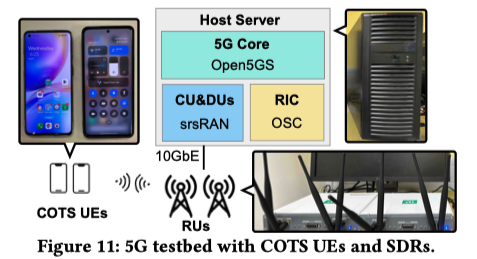
- 软硬件基础:RANPilot 基于开源的 srsRAN 协议栈实现
- 使用两台软件无线电(USRP X310 SDRs)作为无线电单元(RU)
- 使用配备可编程 SIM 卡的商用智能手机(OnePlus 8T 和 Xiaomi 13 Pro)作为终端设备
- 计算节点与核心网:
- 系统托管于一台运行 Ubuntu 22.04.1 LTS 的工作站上(配备 Intel Xeon CPU 和 NVIDIA RTX 4090 GPU)
- 在此工作站上部署了 Open5GS 以提供 5G 核心网功能
- 控制面与模型开销:采用 OSC RIC 框架进行控制面支持与 AI 集成
- 其中的 KPM 增强模型(包含6个 Transformer 块)训练效率较高
- 对1小时数据进行预训练耗时约18分钟,对10分钟数据进行持续微调仅需约3分钟,且 GPU 显存(VRAM)占用仅为 1.5 GB 左右
Integration with O-RAN Architecture. RANPilot enforces strict compute isolation to protect time-sensitive control loops in O-RAN operation. Only the lightweight KPM collection module is implemented as an xApp within the Near-RT RIC, while the heavy data synthesis and augmentation modules are deployed entirely in the Non-RT RIC. In addition to the basic KPMs provided by srsRAN, we integrate custom hooks [24] into the stack to capture more granular and informative KPMs every 40 ms. Operators configure RANPilot via open APIs, enabling it to leverage the realistic database to emulate reconfigured RAN and develop diverse AI functionalities. Once the new configuration is online, the updated AI models are immediately activated to provide robust network control and optimization.
- 严格的计算隔离:为了不影响 O-RAN 中对时间极度敏感的控制循环
- 系统将轻量级的“KPM 收集模块”作为 xApp 部署在近实时控制器(Near-RT RIC)中
- 而计算繁重的“数据合成与增强模块”则完全部署在非实时控制器(Non-RT RIC)中
- 细粒度数据采集:
- 除了收集基础的 KPM 外,研究人员还在协议栈中植入了自定义钩子(hooks),以每 40 毫秒一次的高频率捕获更细粒度、信息量更大的 KPM 数据
- 无缝衔接与激活:运营商可以通过开放 API 配置 RANPilot 来模拟重构并开发 AI 功能
- 一旦新的网络配置在物理层面正式上线,RANPilot 更新好的 AI 模型就会立即激活,无缝接管并提供稳健的网络控制
Discussion and Future Work¶
Design scope and assumptions. RANPilot is designed to facilitate proactive AI adaptation for operator-initiated reconfigurations within individual base stations, rather than citywide, synchronized cellular rollouts spanning massive cell sites. Given that typical base stations operate with 1∼4 cells, our system evaluation is grounded on a typical O-RAN base station mirroring this cell settings. The RANPilot’s capability of synthesizing KPM traces and adapting AI models is based on two assumptions: (1) the seed KPMs harvested during the pre-reconfiguration stage should capture the site-specific complexities of cellular networks (e.g., outdoor nature, number of users, mobility and traffic patterns, channel conditions, cell densities and capacities); and (2) the planned reconfiguration only alters RAN components, whereas external environmental features and user behavior profiles remain largely consistent.
设计范围与基本假设 (Design scope and assumptions)
- 适用范围:
- RANPILOT 专为单个基站(通常包含 1~4 个小区)内由运营商发起的网络重构而设计,并不针对全城范围内的大规模同步蜂窝网络部署
- 两大假设:
- 预重构阶段收集的种子 KPM(关键性能指标)必须能够捕捉到该特定站点的复杂网络特征(如用户数、移动性与流量模式、信道条件等)
- 计划中的重构仅改变 RAN(无线接入网)组件,而外部环境特征和用户行为模式保持基本不变
Limitations and failure boundary. (1) Seed KPM Consistency: RANPilot’s data synthesis relies on the empirical consistency of seed KPMs. A failure boundary emerges when this consistency is disrupted, such as deploying new RUs in unserved areas or experiencing extreme spatial variations (Figure 12(f)). In these scenarios, the lack of site-specific historical traffic patterns and channel dynamics can compromise the fidelity of synthetic data. RANPilot can resolve these inconsistencies after system changes by incremental learning. (2) Advanced PHY Techniques: modern 5G/6G networks adopt advanced PHY technologies (e.g., massive MIMO, beamforming, mmWave), which expand the network’s operational and reconfiguration space. Fully mapping these PHY changes to system-level performance impacts remains an open challenge. RANPilot abstracts PHY changes into signal strength variations using a simplified wireless channel model. Our future work will explore integrating PHY-foreseeing emulation to support proactive adaptation for complex PHY policy changes (e.g., beamforming).
局限性与失效边界 (Limitations and failure boundary)
- 种子 KPM 一致性中断:
- 如果在新未覆盖区域部署新 RU 或遇到极端的空间变化
- 由于缺乏该特定站点的历史流量与信道动态,合成数据的保真度会受损
- 目前 RANPILOT 依靠部署后的增量学习来解决这一偏差
- 高级物理层 (PHY) 技术建模挑战:
- 现代 5G/6G 采用了大规模 MIMO、波束赋形等高级 PHY 技术,很难将其变化完全映射到系统级性能影响上
- 目前 RANPILOT 仅通过简化的无线模型将其抽象为信号强度变化
- 未来将探索整合 "PHY 预测仿真" 以支持复杂的物理层策略变更
Robustness for unplanned changes. RANPilot targets data drift introduced by planned, operator-initiated RAN reconfigurations, where network changes are known ahead of deployment. In real-world operations, unplanned changes may also introduce sudden or gradual data drift that invalidates deployed AI models. Examples include sudden CBRS license changes due to higher-priority incumbents, bursty UE surges triggered by mass gatherings, and environmental dynamics such as new transmitters/reflectors that alter radio propagation. Mitigating such unplanned changes requires orthogonal mechanisms. For example, scaling the training dataset to encompass diverse unplanned dynamics, thereby enhancing the AI model’s inherent robustness, or deploying reactive, online calibration strategies to fix performance gaps after the drift is observed [92]. Fully addressing AI robustness under unplanned network changes requires RANPilot to work together with these online calibration mechanisms and remains a promising direction for future work.
应对“非计划变更”的鲁棒性
- RANPILOT 目前针对的是部署前已知的“计划内”重构
- 对于现实中意外引发的数据漂移(例如突发的频谱许可证变更、大型集会引发的瞬时流量激增、环境物理变化等),需要结合正交机制(如扩大训练集以涵盖多变场景,或部署反应式在线校准策略)与 RANPILOT 协同工作,这也是未来颇具前景的研究方向
AI-native data synthesis. While RANPilot enables proactive AI adaptation, it still relies on human intervention to bootstrap the data-synthesis pipeline: operators must explicitly provide reconfiguration plans via RAN and AI APIs. Looking ahead, the broader AI-RAN vision [4, 9] for NextG cellular systems aims for a fully AI-native architecture, in which the RAN autonomously determines when and how to reconfigure. Realizing such a paradigm would require the control plane to automatically infer performance bottlenecks, synthesize candidate reconfiguration plans, and seamlessly trigger RANPilot to generate synthetic KPM data and update deployed AI models, entirely without operator guidance. Our future work will explore AI-native data synthesis for the evolution of intelligent, self-optimizing RANs.
向“AI 原生”数据合成演进
- 现状:
- 目前 RANPILOT 仍需人工干预,即运营商必须通过 API 显式输入重构计划来启动数据合成管道
- 未来愿景:
- 面向下一代蜂窝系统(NextG)的 AI-RAN 愿景是打造完全的“AI 原生”架构
- 未来网络控制平面将能够自动推断性能瓶颈、自主生成重构计划,并在完全无需人工指导的情况下,无缝触发 RANPILOT 生成合成数据并更新 AI 模型