Synchronizing with the Scheduler: Dual-Loop Congestion Control for 5G Uplink on Commodity Devices
TLDR
(1) 研究背景与核心痛点:
-
现状与挑战:
- 高清视频会议、移动直播等应用对5G/LTE上行链路的吞吐量和延迟要求极高
- 然而,现有的端到端拥塞控制算法(如 BBR、CUBIC、GCC 等)依赖于 RTT 或 PktLoss 来作为反馈信号,这些信号的更新往往需要几十到上百毫秒
-
根本矛盾:
- 这种传输层的慢反馈与 RAN 毫秒级的资源调度速度之间存在严重的时间尺度错配(Timescale Mismatch)
- 这导致现有的协议只能“盲目驾驶”,要么过度发送导致队列膨胀(Bufferbloat),要么因发送不足而浪费带宽
(2) 核心创新: 发现并定义 GBR 信号
-
GBR (Grant-to-Buffer Ratio):
- 作者提出了一种全新的毫秒级拥塞信号: 授权与缓冲区请求比 (Grant-to-buffer Ratio)
-
工作原理:
- 在蜂窝网络中,UE 必须先通过 BSR(Buffer Status Report)向基站报告其缓冲区中有多少数据要发,基站根据当前负载情况通过 Uplink Grant 分配实际传输资源
-
信号意义:
- GBR 就是 "基站实际给的资源" 除以 "手机申请的资源"
- 当基站空闲时,GBR通常大于或等于 1
- 当基站拥塞时,基站不得不削减分配,GBR 会下降到小于 1
-
优势:
- GBR 信号更新极快(约每5毫秒一次),不受数据平面排队延迟的影响
- 可以直接在现有的商用智能手机上获取,完全不需要对 gNB 基础设施进行任何修改
(3) 系统设计: GBR-CC 双环路拥塞控制
基于 GBR 信号,作者设计了 GBR-CC 拥塞控制算法,采用了 "Dual-Loop" 架构:
-
毫秒级内环 (Inner Loop):
- 将 GBR 作为快速响应信号, 连续估计物理可用容量
- 在数据堆积产生排队延迟之前, 以 ms-level 的频率主动调整数据包的发送速率
-
传统的端到端外环 (Outer Loop):
- 监控 E2E RTT 趋势,作为保守的回退机制, 专门用于处理非无线侧的瓶颈 (例如: 有线回程链路的拥塞)
(4) WebRTC 适配与体验优化 (QoE-Aware Tuning)
-
将 GBR-CC 直接应用于视频流时:
- 过于敏锐的链路容量跟踪, 会导致视频码率剧烈波动
- 进而引发: 接收端抖动缓冲区(Jitter Buffer)膨胀, 反而增加播放延迟
-
为此,作者对增益函数(Sigmoid Gain Mapping)进行了参数调整:
- 修改了陡峭度参数 \(\beta\)
- 扩大了目标比率附近的 "死区(Neutral zone)"
- 这样可以: 在面临微小网络波动时保持发送速率稳定,从而保障了高 QoE
(5) 实验评估与性能表现
在 AT&T、Verizon 和 T-Mobile 的商用 LTE 和 5G(FDD/TDD)网络上进行了广泛的真实世界测试:
-
大文件传输 (Bulk Transport):
- 相较于 BBR,GBR-CC 将平均吞吐量提高了5%,并将中位 RTT 缩减了一半
-
实时视频流 (WebRTC):
- 相较于 WebRTC 默认的 GCC 算法,GBR-CC 将平均吞吐量提升了50%
- 同时: 将中位端到端播放延迟大幅降低了 32-53%,视频卡顿率减少了约 60%
Introduction
Cellular networks are experiencing a surge in uplink-intensive, realtime applications. 1 From high-definition video conferencing [10, 20, 28] and mobile live streaming (e.g., Twitch [40], TikTok [39]) to teleoperated robotics [7, 18], these services demand consistent high throughput and low latency from the device to the cloud. However, the cellular uplink remains a critical bottleneck. Unlike the downlink, where base stations utilize high transmission power, large antenna arrays, and complex signal processing, the uplink is strictly limited by the user equipment’s (UE) restricted size, battery power, and computational capacity. As a result, the uplink is inherently vulnerable: even slight variations in signal strength or multi-user contention can cause immediate capacity drops [19, 24, 49].
In such a constrained environment, the congestion control (CC) algorithm is the primary line of defense. However, achieving lowlatency, high-throughput uplink transmission remains an elusive goal for existing transport protocols. The root cause is their inability to track the rapidly changing cell load due to a fundamental timescale mismatch between the transport layer and the Radio Access Network (RAN). While the RAN scheduler reallocates resources on a sub-millisecond timescale [5, 30, 48], traditional transport protocols [8, 10, 11, 13, 16, 22, 43, 44, 50, 54] rely on end-to-end feedback loops that are often orders of magnitude slower. This inherent lag forces existing algorithms to drive blind: by the time an end-to-end signal reports congestion, the radio state has already shifted. As a result, senders inevitably oscillate between overdriving the link (causing bufferbloat) and underutilizing available capacity [24, 25, 37, 49, 55].
To bridge this gap, a significant body of research relies on explicit feedback or in-network assistance from the cellular infrastructure. Proposals like L4S [12, 42] and cellular-specific ECN [15, 21, 26, 35] utilize explicit congestion notification to signal saturation. Octopus [14] leverages in-network assistance to drop packets or adapt content proactively. While these methods offer high accuracy by directly exposing the base station’s state, they face prohibitive deployment barriers: they require modifications to proprietary, closed-source base station hardware.
Alternatively, researchers have explored client-side cross-layer approaches to infer channel quality. Approaches like NG-Scope [47], NR-Scope [41], and piStream [45] use physical layer sniffing but require expensive external hardware, e.g., software-defined radios like USRP, making them impractical for ubiquitous deployment. Conversely, tools like MobileInsight [30, 31] operate on commodity smartphones by decoding control-plane signaling; however, monitoring a single device provides no visibility into the demands of other users. Since a device can only observe its own state, it cannot infer total cell load or reliably distinguish between self-inflicted congestion and multi-user contention.
In this paper, we ask: Is it possible to infer the precise load of the base station directly from a commodity mobile device, in real-time, without infrastructure support?
We answer affirmatively by identifying a fast, closed-loop control mechanism native to the cellular architecture: the buffer status report (BSR) to uplink grant loop [1]. In cellular protocols, both LTE and 5G, a UE cannot transmit without permission; it must first report its queue size via BSR to the base station, which then allocates resources based on availability and notifies the UE via uplink grants. We observe that the ratio between what the device asks for and what the network grants serves as a high-fidelity, instantaneous proxy for cell load. Intuitively, when a cell is lightly loaded, the base station can fully satisfy the device’s uplink demand; however, as contention rises and multiple users compete for finite radio resources, the scheduler must ration grants, causing the allocated capacity to drop below the reported demand.
This mechanism offers decisive advantages over traditional feedback signals. First, it enables a millisecond-scale control loop capable of reacting to rapid wireless dynamics, by providing updates at a high frequency (approximately every 5 ms). Second, unlike data packets which get trapped in standing queues, BSR and Grant messages travel on dedicated control channels, rendering them immune to the buffering delays (RTT inflation) that make end-to-end signals stale. Finally, this approach leverages standard collaboration from the base station without requiring any modifications to cellular infrastructure, as the telemetry is accessible on commodity UE via standard diagnostic interfaces.
We formalize this insight as the Grant-to-BSR Ratio (GBR), defined as the ratio of the allocated uplink Grant size to the queue depth reported via BSR. To verify that GBR is a reliable indicator of instantaneous cell load, we conducted an extensive half-year measurement campaign across three major US carriers, i.e., AT&T, Verizon, T-Mobile, covering diverse LTE and 5G (FDD and TDD) deployments. By systematically varying background traffic to modulate the actual cell load, we confirmed a strong negative correlation between the GBR and the cell load. Our measurements show that while the cell is uncongested, the GBR holds at >= 1, i.e., granted resource is larger than UE requested; crucially, as the cell saturates and the scheduler forces throttling, the GBR drops proportionally below one, confirming that the GBR is a high-fidelity proxy for base station saturation.
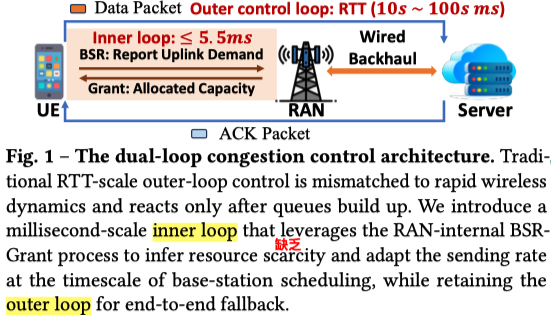
Guided by this insight, we design and implement GBR-CC, a congestion control algorithm with a dual-loop architecture that decouples adaptation to wireless capacity from end-to-end dynamics, as shown in Figure 1. The core innovation is the millisecond-scale inner loop, which acts as a fast-response traffic shaper. By monitoring the GBR in real-time, this loop continuously estimates the available physical capacity and adjusts the packet pacing rate accordingly before queues accumulate. This transforms congestion control from a reactive process, i.e., waiting for standing queues to trigger end-to-end signals, into a proactive one that synchronizes the sender with the base station’s scheduler. Simultaneously, a traditional outer loop monitors end-to-end delay trends to handle non-radio bottlenecks e.g., shared backhaul congestion.
To demonstrate the applicability of GBR-CC to the real-time interactive applications, we merge it into WebRTC stack. Directly applying the aggressive capacity tracking of GBR-CC to video traffic is suboptimal; the resulting rapid bitrate fluctuations destabilize the video encoder, causing the receiver’s jitter buffer to inflate and unintentionally degrade playout latency. Therefore, we introduce a QoE-aware tuning that tunes the controller’s rate adaptation aggressiveness. We desensitize the controller to minor channel variations to avoid unnecessary rate oscillations. This modification prioritizes rate stability over perfect bandwidth matching during minor fluctuations, preventing jitter buffer bloat while retaining the ability to react instantly to congestion.
We implement GBR-CC on commodity Android smartphones. Extensive experiments across commercial LTE and 5G networks demonstrate that GBR-CC significantly outperforms state-of-the-art baselines: in bulk transport scenarios, it reduces median RTT by up to 4× compared to loss-based schemes while delivering 2. 5× the throughput of delay-based alternatives. When integrated into WebRTC for real-time video, GBR-CC reduces median end-to-end playout latency by 32–53% and cuts video freeze rates by approximately 60%, effectively eliminating the stalls that plague interactive applications in dynamic cellular environments.
Ethics. This work does not raise any ethical issues.
Contributions. Our contributions are as follows:
- GBR Congestion Signal.
- We identify the GBR, a novel millisecondscale proxy for cell load accessible on commodity smartphones without infrastructure modifications.
- Measurement-Driven Validation.
- Extensive campaigns across AT&T, Verizon, and T-Mobile confirm GBR strongly correlates with base station load, detecting congestion orders of magnitude faster than end-to-end feedback.
- Dual-Loop Congestion Control.
- We design GBR-CC, which integrates a millisecond-scale inner loop for proactive rate adaptation and an end-to-end outer loop to handle non-radio bottlenecks.
- We adapt GBR-CC to WebRTC through QoE-aware tuning, enabling scheduler-level RAN signals to guide real-time video without destabilizing the encoder and jitter buffer.
-
研究背景与核心痛点:
- 蜂窝网络的 UL 正成为高清视频会议、移动直播和遥操作机器人等实时应用的严重瓶颈
- 现有的端到端拥塞控制协议无法追踪基站负载的快速变化,存在严重的"时间尺度错配":
- RAN 调度处于亚毫秒级,而传统传输层的反馈机制则慢了几个数量级,导致协议常常在 队列膨胀 和 带宽利用不足 之间来回震荡
-
现有方案的局限性:
- 依赖基础设施辅助 (L4S / 在网 ECN) 的方案 需要修改闭源的专有基站硬件, 部署门槛极高
- 现有的客户端跨层探测方案:
- 要么: 需要昂贵的外部硬件设备 (NG-Scope, NR-Scope, and piStream)
- 要么: 只能监控单台设备, 无法准确推断出多用户竞争下整个小区的负载情况 (MobileInsight)
-
核心创新点 - GBR 信号:
- 论文挖掘了蜂窝架构中原生的一种闭环控制机制,即: 缓冲区状态报告(BSR)与上行链路授权(Grant)的交互过程
- 作者 将 基站分配的授权资源 与 设备报告的请求资源 之比定义为 GBR(Grant-to-BSR Ratio)
- 以此作为: "基站瞬时拥塞状态" 的高保真代理信号
-
GBR 信号的验证与优势:
- 在三大运营商(AT&T、Verizon、T-Mobile)的大量测量证实:
- 小区未拥塞时 GBR 保持在 1 或以上
- 小区饱和拥塞时该比率会下降到 1 以下
- 该信号具备:
- 约 5 毫秒的极快更新频率
- 对数据面排队延迟免疫(走专用控制信道)
- 无需对现有基站进行任何修改即可在商用手机上获取
- 在三大运营商(AT&T、Verizon、T-Mobile)的大量测量证实:
-
系统设计 (Dual-loop CC):
- 基于 GBR 信号,作者设计了 GBR-CC 算法架构
- 该架构包含一个基于 GBR 信号以毫秒级运行的“内环”,用于快速且主动地适应无线信道容量
- 同时保留了一个基于端到端延迟的“外环”,作为应对非无线侧(如有线回程)网络瓶颈的保守回退机制
-
实时视频应用的体验优化 (WebRTC 适配):
- 如果直接将高度敏感的 GBR 跟踪应用到视频流中会导致码率剧烈波动,进而使接收端的抖动缓冲区(Jitter Buffer)膨胀并恶化延迟
- 因此,作者引入了 QoE 感知调优,降低控制器对微小信道波动的敏感度,从而在保持实时反应能力的同时防止抖动缓冲区的异常膨胀
-
实验成果与显著贡献:
- 大容量传输场景中,GBR-CC 相比基于丢包的方案将中位 RTT 降低了 4 倍,吞吐量是基于延迟方案的 2.5 倍
- WebRTC 实时流中,GBR-CC 使得端到端的中位播放延迟下降了 32–53%,视频卡顿率降低了约 60%
Background and Motivation
This section explains the limitations of existing cellular congestioncontrol approaches, then introduces GBR as a practical schedulerlevel signal for building a dual-loop congestion controller.
2.1 Congestion Control in Cellular Network.
Traditional congestion control algorithms, whether loss-based (e.g., CUBIC [22]), delay-based (e.g., GCC [10], Verus [54], Sprout [44]), or model-based (e.g., BBR [13]), fundamentally struggle in cellular environments due to two fundamental problems with end-to-end feedback. First, these signals are lagged: structurally, they are too slow to track rapid wireless dynamics. While the RAN scheduler reallocates resources at sub-millisecond timescales, transport feedback is governed by the Round-Trip Time (RTT), which is frequently inflated by deep buffers to hundreds of milliseconds, forcing protocols to react to network states that have already shifted. Second, these signals are inaccurate: they lack visibility into RAN-internal information. Because endpoints treat the network as a black box, they are blind to the base station’s actual scheduling decisions and resource availability. This forces algorithms to guess the congestion state based on noisy symptoms (delay or loss) rather than the root cause, leading to persistent rate mismatches.
2.1.1 Network-Side Signaling
Ideally, the base station—which possesses complete knowledge of network dynamics—would explicitly notify senders of congestion. Proposals such as ABC [21] and Octopus [14] suggest modifying the base station to mark packets with capacity information. While these methods help to accurately estimate network capacity, they cannot shorten the control loop, meaning the estimation still risks becoming outdated by the time it reaches the sender. Zhuge [35] attempts to shorten the feedback loop by having the base station predict queuing delays and generate feedback immediately, thereby eliminating the latency associated with packet queuing and air interface transmission. The architecture of Zhuge limits itself to downlink traffic. More importantly, these solutions face prohibitive deployment barriers. They require modifications to closed, proprietary RAN infrastructure and rely on changing 3GPP standards, which is impractical for immediate deployment.
2.1.2 UE-Side Cross-Layer Solution
To address this, recent research has pivoted toward cross-layer approaches that expose RAN internals at the UE side. We classify these into two paradigms: hardware-based global sniffing and clientside local telemetry.
The Gold Standard: Hardware-Based Global Visibility. The theoretical ideal for congestion control is perfect visibility into the base station’s load. Tools like NG-Scope [47], NR-Scope [41], and piStream [45] achieve this by monitoring the physical downlink control channel or physical spectrum energy using Software-Defined Radios (SDRs). PBE-CC [48] builds a congestion control algorithm atop NG-Scope [47] and demonstrate superior performance. While scientifically robust, this approach requires expensive and bulky external hardware (USRPs), making it deployment-prohibitive. Furthermore, decoding the control channels of all users raises significant privacy concerns in commercial networks.
UE-Side Local Telemetry. Instead of external hardware, softwarebased tools like MobileInsight [30], QCSuper [38], XCAL [6], extract internal metrics directly from the mobile device’s modem. Various algorithms leverage these metrics to guess network conditions: CLAW [46] correlates signal quality (RSRQ) with base station load; PERCEIVE [29] uses machine learning on resource allocation patterns; H2MO [33] detects handovers to predict capacity drops; and Prism5G [51] tracks carrier aggregation to anticipate bandwidth jumps, e.g., when a secondary carrier is activated, capacity might jump from 50 Mbps to 500 Mbps instantly.
However, these methods face two critical limitations. First, and most importantly, they lack a holistic view. Because a base station serves many users simultaneously, the metrics observed by a single device, such as its own allocated bandwidth or signal interference, cannot capture the aggregate contention in the cell. Second, existing extraction tools generally cannot expose this data in real-time, often introducing seconds of delay that make the signals useless for realtime active congestion control, so that most of the algorithms are tested using trace-driven emulation.
-
传统端到端协议的固有缺陷:
- 无论是基于丢包还是基于延迟的算法,其反馈信号都存在严重滞后(受深度缓冲区带来的 RTT 膨胀影响)
- 且: 由于无法感知 RAN 的内部状态,导致这些算法只能盲目猜测网络拥塞情况
-
网络侧信令(基础设施修改)难以落地:
- 虽然让 gNB 直接通知发送端拥塞状态最为准确,但这需要修改闭源、专有的 RAN 基础设施,并依赖 3GPP 标准的变更,部署门槛极高
-
客户端跨层方案存在盲区:
- 依赖外部硬件 (如 USRP) 嗅探物理层的方案过于昂贵且侵犯隐私
- 依赖手机提取本地指标(如 MobileInsight)的软件工具则缺乏全局视角,无法实时反映小区内的多用户竞争总负载
积累一下, 感觉下一篇文章会用得上:
| 蜂窝网络的拥塞控制 | 例子 |
|---|---|
| loss-based CC | CUBIC [22] |
| delay-based CC | GCC [10], Verus [54], Sprout [44] |
| model-based CC | BBR [13] |
| (gNB-side) Network-Side Signaling | ABC [21], Octopus [14], Zhuge [35] |
| (UE-side) Hardware-Based Global Visibility | NG-Scope [47], NR-Scope [41], piStream [45], PBE-CC [48] |
| (UE-side) UE-Side Local Telemetry | MobileInsight [30], QCSuper [38], XCAL [6] |
| (UE-side) 根据遥测推断网络情况 | CLAW [46], PERCEIVE [29], H2MO [33], Prism5G [51] |
2.2 New Vantage Point: The BSR-Grant Loop
The cellular network architecture inherently contains a fast, closed-loop control mechanism that can be leveraged to infer base station load without infrastructure modifications.
2.2.1 BSR-to-Grant Loop
Cellular networks are centralized architectures where a mobile device cannot transmit uplink data without explicit permission. The cycle begins when data enters the UE’s uplink buffer, triggering the UE to send a BSR to the base station indicating the volume of queued data. In response, the base station scheduler evaluates this request against available resources, issuing an uplink grant that specifies exactly how many bytes the UE is permitted to transmit.
Crucially, this interaction reveals the instantaneous load of the cell. The mobile device always requests the resources necessary to clear its buffer. Whether the base station grants this full amount depends heavily on its current load. When the base station is not saturated and possesses sufficient bandwidth, the granted resources match the reported demand. Conversely, when the cell is congested, either by the device’s own traffic or aggregate demand from multiple users, the granted resources fall short of the request. This discrepancy serves as a direct indicator of base station saturation.
2.2.2 New Signal of Congestion: Grant-to-BSR Ratio (GBR)
The relationship between what a UE asks for (BSR) and what it receives (Grant) provides a direct signal of base station saturation. We define the Grant-to-BSR Ratio (GBR) 𝜂 as:
where the 𝑅 𝑔𝑟𝑎𝑛𝑡 is the resource granted by the cell and the 𝑅 𝑏𝑠𝑟 is the resource requested by the mobile device via BSR.
Signal Interpretation and Cell Load Correlation. The GBR acts as a proxy for the base station’s scheduler state. When 𝜂 ≥ 1, the base station is uncongested, possessing sufficient bandwidth to satisfy the UE’s demand immediately. Interestingly, 𝜂 can slightly exceed 1 in this state because the base station may allocate extra padding to prevent fragmentation or to accommodate traffic arriving between the BSR and the grant. Conversely, when 𝜂 < 1, the base station is saturated. In this regime, the scheduler cannot satisfy the aggregate demand, forcing it to clip the UE’s request; the lower the ratio, the more severe the congestion. This monotonic relationship transforms the ratio from a simple accounting metric into a high-fidelity congestion signal.
2.2.3 Advantages of the GBR Signal
The GBR offers five distinctive advantages that overcome the limitations of prior approaches.
Shortest Control Loop. The BSR-to-Grant RTT represents the tightest feedback loop in the cellular stack. In FDD, the base station can grant resources in the very next TTI. In TDD, despite frame structure constraints requiring a wait for a downlink slot, our empirical results confirm the delay is strictly bounded below 5.5 ms, orders of magnitude faster than transport-layer RTTs.
Frequent Signal Updates. To maintain uplink transmission, the mobile device must periodically report its buffer status. This periodicity is configured by the network through RRC signaling: the RRC Reconfiguration message carries the BSR-Config, which specifies the periodicBSR-Timer parameter [2, 4]. We obtain this value in real time by parsing the RRC Reconfiguration message. Appendix D describes the complete parsing workflow for computing GBR, including how uplink grants are extracted and aligned with BSR reports. In our traces, the base station sets this timer to 5 ms across three major U.S. operators. Since every BSR generates a corresponding grant evaluation, the GBR signal updates at this exact frequency, allowing the controller to track millisecond-scale wireless dynamics without relying on delayed end-to-end transport feedback.
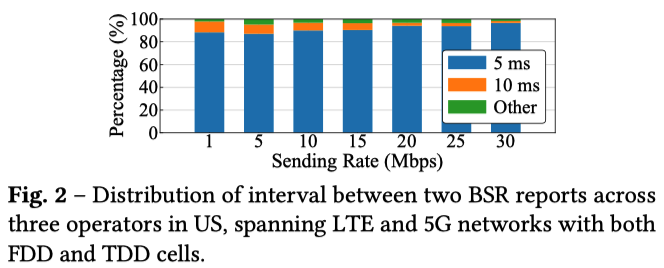
Immunity to Buffer Bloat and Inflated RTT. BSRs and Grants are control-plane messages prioritized over user data. Even when the data plane is heavily congested and buffering (inflating RTT), the BSR-Grant loop continues to operate on its millisecond schedule, providing a lag-free signal of congestion. Consequently, the feedback loop continues to operate reliably on its predefined schedule even when the cell is saturated and data buffers are overflowing. Figure 2 validates this behavior across multiple operators. We increased the sending rate up to 30 Mbps, a load that significantly exceeds the available uplink capacity in all our tests. Despite this heavy saturation, the measured BSR interval remains tightly clustered around its 5 ms schedule, confirming that the BSR reporting interval operates independently of the cell load.
Availability at Commodity Mobile Device. The BSR and Grant messages required to compute GBR are accessible on standard commercial hardware through vendor diagnostic interfaces available on Qualcomm and MediaTek chipsets. Existing tools, e.g., Qualcomm DIAG [6], MobileInsight [30], and QCSuper [38], can access these interfaces and expose low-level modem messages. We have developed a tool, CellNinjia, to parse these messages and expose the derived GBR in real time on modern 5G smartphones.
Implicit Network Assistance. The GBR signal effectively provides network-assisted congestion control, leveraging the cell’s precise knowledge of cell load, without requiring any modifications to the cell itself or deployed base-station software. It exploits a standard, mandatory procedure defined in 3GPP specifications [1–4], making it immediately deployable on existing networks.
-
原生调度机制:
- 在蜂窝网络中,手机必须先通过 BSR 上报数据量,基站再根据当前资源情况下发 Grant
-
定义 GBR:
- 作者将 "基站授权的资源" 与 "手机 BSR 请求的资源" 之比 定义为 GBR(Grant-to-BSR Ratio, 即 \(\eta\))
-
准确反映基站负载:
- 当 \(\eta \ge 1\) 时, 说明基站空闲, 能完全满足手机需求
- 略微大于 1 的情况是成立的, 因为会有一些 padding 的机制, 用于一些校验之类的操作
- 当 \(\eta < 1\) 时, 说明基站饱和, 调度器被迫对手机的请求进行“削顶”
- 该比率直接揭示了拥塞程度
- 当 \(\eta \ge 1\) 时, 说明基站空闲, 能完全满足手机需求
- 反馈极快:
- 提供了蜂窝协议栈中最短的控制反馈环路,信号更新频率极高(约每 5 毫秒一次)
- 免疫排队延迟:
- 因为 BSR 和 Grant 属于控制面消息,其优先级高于用户数据,故不受数据面排队造成的 RTT 膨胀影响
- 如: Figure 2 所示验证了在 30 Mbps 高强度饱和打流下,BSR 上报间隔依然稳定在 5 毫秒
- 部署友好:
- 无需修改基站或基础设施,通过商用智能手机的标准诊断接口(如高通或联发科芯片)即可直接获取并计算该信号
2.3 New Architecture: Dual Loop Control
Building on the discovery of the BSR-Grant Ratio, we propose a novel Dual-Loop Congestion Control architecture for cellular uplink traffic. As illustrated in Figure 1, this architecture integrates two distinct feedback mechanisms: a conventional outer loop governed by data packets and ACKs, and a fast inner loop driven by BSR and Grant messages.
Outer Loop. This loop, employed by traditional end-to-end algorithms, detects capacity across the entire network path. It remains essential for identifying bottlenecks that occur outside the RAN, such as in the wired backhaul.
Inner Loop. This loop explicitly targets the wireless connection between the UE and the base station. By monitoring the GBR, it provides immediate visibility into RAN-specific dynamics that end-to-end signals often miss or delay.
By synthesizing these two layers of information, our architecture achieves the best of both worlds: it rapidly adapts to fast-varying cellular dynamics via the inner loop, while retaining the ability to detect and react to non-radio bottlenecks situated in the wired backhaul via the outer loop.
-
架构设计:
- 基于 GBR 提出了一种全新的拥塞控制架构
-
内环 (Inner Loop):
- 由 BSR 和 Grant 消息驱动,专注于实时监控 GBR,以毫秒级速度应对无线接入网内部的快速动态变化
-
外环 (Outer Loop):
- 保留传统的端到端控制循环(基于数据包和 ACK),作为兜底机制,专门用于检测和应对无线网络之外的瓶颈(如共享的有线回程网络拥塞)
GBR: The Formulation, Empirical Validation, and Benchmarking
不纠结, 直接跳过
GBR-Driven Controller Design
不纠结, 直接跳过
Evaluation
We evaluate GBR-CC through extensive real-world experiments over commercial LTE, 5G FDD, and 5G TDD networks to demonstrate its ability to adapt to rapid cellular dynamics.
为了验证 GBR-CC 适应快速蜂窝网络动态变化的能力,我们在商用 LTE、5G FDD 和 5G TDD 网络上对其进行了广泛的真实世界实验评估:
Purely Wild Experiment. We conduct all evaluations on commercial cellular networks rather than network emulators or USRP-based testbed. GBR-CC fundamentally requires a live commercial cellular network for two reasons. First, the GBR signal is generated by the specific interaction between the UE and the base station; without a real cellular stack, this signal is unobtainable. Second, even small-scale testbeds built using USRPs cannot truthfully represent the complex, heavy background traffic and multi-user contention of a commercial network that drive rapid network dynamics.
完全真实的野外实验 (Purely Wild Experiment)
我们将所有评估均部署于商用蜂窝网络上,而非使用网络仿真器或基于 USRP 的测试床
GBR-CC 从根本上依赖于真实的商用蜂窝网络,原因有二:
(1) GBR 信号源于 UE 与 gNB 之间的特定交互
若无真实的蜂窝协议栈,该信号将无法获取
(2) 即使是使用 USRP 搭建的小规模测试床,也无法真实再现商用网络中复杂的重负载背景流量,以及驱动网络快速动态变化的多用户竞争场景
Testbed and Network Configuration. Our experimental testbed consists of a sender (Dell Laptop) and a receiver (Google Cloud Platform server). The sender connects to the cellular network via USB tethering to a smartphone, ensuring that all traffic traverses the commercial uplink path. We utilize three distinct smartphones to cover different radio access technologies: a Pixel 5 for LTE, a OnePlus 9 for 5G FDD, and a Moto G 5G for 5G TDD. For mobile tests, the device moves outdoors at a speed of approximately 1.5 m/s along a repeatable walking route.
测试床与网络配置 (Testbed and Network Configuration)
我们的实验测试床由一个发送端(戴尔笔记本电脑)和一个接收端(谷歌云平台服务器)组成:
发送端通过 USB 网络共享(Tethering)连接至智能手机从而接入蜂窝网络,以此确保所有流量均通过商用上行链路进行传输
为了覆盖不同的无线接入技术,我们使用了三款不同的智能手机:
- Pixel 5 用于 LTE
- OnePlus 9 用于 5G FDD
- Moto G 5G 用于 5G TDD
在移动场景测试中,设备以约 1.5 m/s 的速度沿一条可重复的步行路线在室外移动
就不单开 5.1 了, 只放 experimental setup 相关的即可
Baselines and Metrics. We compare GBR-CC against seven state-of-the-art congestion control algorithms representing diverse design philosophies. These include the loss-based CUBIC [22] (standard TCP/QUIC default), the model-based BBR [13], delay-based algorithms such as Copa [8], Verus [54], and Sprout [44], and learningbased approaches including PCC Vivace [17] and PCC [16]. We utilize the Pantheon framework to run these baseline algorithms. We compare the algorithms based on Throughput and RTT.
基线算法与评估指标 (Baselines and Metrics)
我们将 GBR-CC 与代表不同设计理念的七种 SOTA 的拥塞控制算法进行了对比
这些算法包括:
- 基于丢包的 CUBIC [22](TCP/QUIC 的标准默认算法)
- 基于模型的 BBR [13]
- 基于延迟的算法(如 Copa [8]、Verus [54] 和 Sprout [44])
- 基于学习的方法(包括 PCC Vivace [17] 和 PCC [16])
我们利用 Pantheon 框架来运行这些基线算法,并基于 Throughput 和 RTT 对这些算法进行性能比较
Experimental Protocol. We utilize secnetperf to perform bulk data uploads under both static and mobility scenarios. To ensure fairness and mitigate the impact of background traffic, we employ a round-robin interleaved testing schedule. For each network scenario (LTE, 5G FDD, 5G TDD), we collect five groups of measurements. Inside each group, the execution order of the algorithms is rotated. Each individual run transfers a fixed payload of 200 MB for LTE experiments and 1 GB for 5G experiments. These sizes are selected to ensure the session lasts long enough to capture steady-state queuing dynamics and valid statistical distributions.
实验规程 (Experimental Protocol)
我们在静态和移动场景下,均使用 secnetperf 工具执行大容量数据(bulk data)的上行传输
为了确保实验的公平性并尽可能消除背景流量带来的影响,我们采用了轮询交错(round-robin interleaved)的测试调度策略
针对每一种网络场景(LTE、5G FDD、5G TDD),我们分别收集了五组测量数据. 在每一个测试组内,各算法的执行顺序会被依次轮换
在单次测试运行中,LTE 实验设定了 200 MB 的固定传输负载,而 5G 实验的负载则为 1 GB
设定这些传输量是为了确保 session 能够维持足够长的时间,从而能够准确捕捉稳态下的排队动态并得出有效的统计分布结果
Related Work
End-to-End Congestion Control. Traditional algorithms [8, 10, 11, 13, 16, 22, 23, 43, 44, 50, 54] infer congestion from end-to-end signals like packet loss or delay. In cellular networks, these signals suffer from two fundamental problems. First, they are lagged: RAN schedulers operate at sub-millisecond frequencies, while end-to-end feedback is delayed for RTT, forcing protocols to react to stale states. Second, they are inaccurate: lacking visibility into RAN resource availability, they rely on noisy symptoms (loss or delay) rather than the root cause. In contrast, GBR-CC’s inner loop synchronizes directly with the base station’s millisecond-scale scheduling to address both issues.
Network-Assisted and Explicit Feedback. To address wireless opacity, proposals like L4S [12, 42], ABC [21], XRC[26], Octopus [14], Sidekick [52], and RAPID [15] use infrastructure signals or proxies to expose capacity. While accurate, these methods face prohibitive deployment barriers, requiring modifications to proprietary base stations or standards. GBR-CC achieves comparable visibility by exploiting the standard BSR-Grant procedure, requiring no infrastructure modifications.
Client-Side Cross-Layer Inference. Existing client-side tools infer link quality but face practicality issues. Tools like NG-Scope [47], NR-Scope [41], and piStream [45] utilize physical layer sniffing to provide precise bandwidth estimation; however, they require expensive, bulky Software-Defined Radios (SDRs), making them impractical for ubiquitous use. Conversely, UE-side telemetry approaches such as CLAW [46], PERCEIVE [29], H2MO [33], Prism5G [51], CQIC [34], Biscay [27], X-TCP [9], and LinkForecast [53] avoid infrastructure changes, but they mainly infer radio conditions or bandwidth changes from local indicators such as RSRQ, resource-allocation patterns, handover events, or carrier aggregation. These local metrics do not directly capture aggregate cell contention, and prior extraction pipelines are often too delayed for real-time active congestion control. GBR-CC overcomes these limitations by using the Grant-to-BSR Ratio as a real-time proxy for global cell load. This signal is accessible on commodity devices without external hardware, directly exposes scheduler-side allocation constraints, and makes RAN contention actionable for congestion control.
很重要, 这一部分大概率是要"回头扫"
| 相关工作分类 | 代表性方案 | 核心机制 | 面临的主要局限性 | GBR-CC 的应对优势 |
|---|---|---|---|---|
| 端到端拥塞控制[cite: 1] | 传统算法 [8, 10, 11, 13, 16, 22, 23, 43, 44, 50, 54][cite: 1] | 通过丢包或延迟等端到端信号推断拥塞情况[cite: 1]。 | 1. 严重滞后:端到端反馈受限于 RTT 延迟,无法跟上亚毫秒级的 RAN 调度频率[cite: 1]。 2. 不准确:缺乏对 RAN 资源的可见性,只能依赖嘈杂的表象信号(丢包或延迟)而非拥塞根源[cite: 1]。 |
算法的内环直接与基站的毫秒级调度保持同步,同时解决了反馈滞后与状态不准确的问题[cite: 1]。 |
| 网络辅助与显式反馈[cite: 1] | L4S, ABC, XRC, Octopus, Sidekick, RAPID[cite: 1] | 利用基础设施信号或代理来显式暴露网络容量[cite: 1]。 | 部署壁垒极高:需要对专有的基站硬件或网络标准进行修改,在现实中极难部署[cite: 1]。 | 巧妙利用标准的 BSR-Grant 交互程序获取了同等级别的网络可见性,完全无需对基础设施做任何修改[cite: 1]。 |
| 客户端跨层推断 (硬件嗅探)[cite: 1] | NG-Scope, NR-Scope, piStream[cite: 1] | 利用物理层嗅探提供极为精确的带宽估计[cite: 1]。 | 硬件限制:严重依赖昂贵且笨重的软件定义无线电 (SDR) 设备,根本无法在日常设备上普及[cite: 1]。 | 直接在普通商用设备上获取信号,无需外接任何硬件设备[cite: 1]。 |
| 客户端跨层推断 (本地遥测)[cite: 1] | CLAW, PERCEIVE, H2MO, Prism5G, CQIC, Biscay, X-TCP, LinkForecast[cite: 1] | 通过 RSRQ、资源分配模式、基站切换事件或载波聚合等本地局部指标来推断无线电状态或带宽变化[cite: 1]。 | 1. 缺乏全局视角:本地指标无法直接捕捉整个小区的聚合竞争状态[cite: 1]。 2. 提取延迟高:此前的提取管道速度过慢,无法满足实时、主动拥塞控制的需求[cite: 1]。 |
将 GBR 作为反映全局小区负载的实时代理信号,直接揭示调度器的分配约束,使 RAN 竞争状态对拥塞控制具有可操作性[cite: 1]。 |
Conclusion
We identify the GBR as a fast and accurate cell-load indicator that infers the base station’s uplink load directly from a commodity mobile device in real time, requiring no infrastructure support. We use GBR to enable GBR-CC, a dual-loop congestion controller for cellular uplinks. We further integrate GBR-CC into WebRTC with QoE-aware tuning, allowing the same RAN signal to guide real-time video without destabilizing the encoder and jitter buffer. Compared to BBR, GBR-CC achieves 5% higher average throughput while reducing the 50th-percentile RTT by 2×; compared to GCC, GBR-CC achieves 50% higher average throughput while simultaneously reducing median end-to-end playout latency by 32–53% and freeze rate by approximately 60%. These results show that exposing scheduler-level congestion signals on commodity devices is a practical way to bridge modem-layer visibility with adaptation at both the transport and application layers.
TLDR: 我们认为 GBR 是一种快速且准确的小区负载指示指标,它能够直接从商用移动设备实时推断基站的上行链路负载,且无需任何基础设施的支持
我们利用 GBR 实现了 GBR-CC,这是一种专为蜂窝网络上行链路设计的双环路拥塞控制器
我们进一步将具有 QoE(体验质量)感知调优机制的 GBR-CC 集成至 WebRTC 中,使得同一 RAN(无线接入网)信号能够指导实时视频流的传输,而不会导致视频编码器和抖动缓冲区(jitter buffer)失稳
与 BBR 相比,GBR-CC 的平均吞吐量提升了 5%,同时将第 50 百分位 RTT 降低了 2 倍;与 GCC 相比,GBR-CC 在将平均吞吐量提升 50% 的同时,使中位端到端播放延迟显著降低了 32–53%,并将视频卡顿率减少了约 60%
这些实验结果表明,在商用设备上暴露调度器级别的拥塞信号,是实现调制解调器层(modem-layer)状态可见性与传输层及应用层自适应调节相衔接的一种切实可行的方法