SAGE: A Real-Time AI System for Reducing Latency in NextG Cellular Networks¶
好文章! 不愧是 EPFL 出品, 值得学习
尤其是 traffic train 的概念提出, 很有意思~
TLDR¶
(1) 研究背景与核心痛点
- 延迟敏感型应用的需求:
- 现代 NextG(下一代)应用(如AR/VR、云游戏、工业自动化、自动驾驶等)对极低的网络延迟有强烈的需求,而上行链路(Uplink)延迟通常是蜂窝网络总延迟的主要瓶颈
- 现有5G调度的两难困境:
- 基于授权的接入(Grant-based access):
- 用户需要先发送调度请求(SR)
- 基站分配初始资源后,用户报告缓冲区状态(BSR)
- 最后基站再分配剩余数据所需的资源
- 这种方式资源利用率高,但会产生多次往返延迟
- 免授权接入(Grant-free access):
- 基站预先为用户分配好资源,用户有数据可直接发送
- 这种方式延迟极低,但在用户无数据发送时会造成严重的资源浪费,扩展性差
- 基于授权的接入(Grant-based access):
(2) 核心创新与解决方案:SAGE 系统
为了打破延迟与资源效率之间的权衡,作者提出了 SAGE,一个部署在5G无线接入网(RAN)中的实时AI系统
它能在毫秒级粒度上预测每个用户的上行流量需求,从而主动分配资源
让数据到达时即可直接发送,消除请求等待时间
提出核心抽象: "流量列车" (Traffic Trains)
- gNB直接观察到的用户流量, 如SR、BSR、MAC层数据包, 往往是被5G协议配置和无线电重传机制扭曲和分割过的"噪音"数据
- SAGE 提出了“流量列车”这一概念:
- 通过时间阈值和HARQ机制, 将紧密到达的数据包和延迟的重传数据重新组合, 还原出用户端真实的应用层流量突发模式
- 这为AI预测提供了一个极其稳定且准确的预测目标
(3) SAGE 的系统架构
SAGE 并不依赖单一的庞大AI模型,而是构建了一个流量感知的模型数据库,包含针对不同流量特征的轻量级AI预测器
系统包含五个实时闭环组件:
- 流量特征提取(Traffic Characterization)
- 对用户的流量进行统计和特征提取,在数据库中匹配最相似的基准配置文件,并检索出对应的轻量级预测模型
- 模型验证(Model Verification)
- 在实际应用预测进行调度前,系统会在后台跟踪模型的预测误差,确认其准确性是否达标
- 预测与调度(Prediction & Scheduling)
- 模型验证通过后,系统利用极低延迟的AI推理,预测下一个“流量列车”的到达时间和大小
- 并采用非对称分配策略为用户提前预留资源
- 在线持续学习(Continual Learning)
- 当预测误差升高(模型验证失败)时,系统会回退到传统调度模式
- 利用最新的流量数据对模型进行在线增量训练,使其适应新的流量特征
- 数据库更新(Database Updating)
- 如果持续学习也无法拯救模型,系统会收集更长时间的数据重新训练一个新模型,并将其注册到模型数据库中
(4) 系统实现与评估结果
作者在真实的5G测试平台(基于开源的 srsRAN 和商业5G终端)上实现了 SAGE,并在8种真实的复杂应用下进行了全面评估
- 降低延迟
- 相比于传统的基于授权的调度,SAGE 将上行链路延迟平均降低了 2.53倍
- 高资源效率
- 在达到与免授权接入相媲美的极低延迟的同时,SAGE 的资源消耗平均减少了最高达 37.5倍(相比于分配全部资源的免授权方案)
- 较于基于授权的基线仅多消耗了1.59倍的预留资源
- 极低的AI开销
- 预测到达时间的中位数绝对误差小于 4 毫秒,且完成一次模型推理的平均开销仅为 0.051 毫秒,完全满足5G RAN的实时性要求
Introduction¶
Over the past decades, cellular networks have achieved remarkable improvements in throughput, to the point where data rates are no longer the primary bottleneck for many applications [16, 17, 79]. The performance frontier has shifted to latency. Modern delaysensitive applications, like mobile AR/VR, cloud gaming, industrial IoT, autonomous vehicles, mobile sensing, and robot navigation or control, increasingly depend on lower latency [2, 8, 18, 27, 32, 33, 39, 49, 61, 91, 92, 96]. Many of these applications rely heavily on uplink traffic for sending video streams, sensing data, motion control data, etc. and studies show that uplink latency is the dominant portion of the total latency in the cellular network [55, 83]. Our goal in this paper is to reduce uplink latency between users and base stations in Next-Generation (NextG) cellular networks.
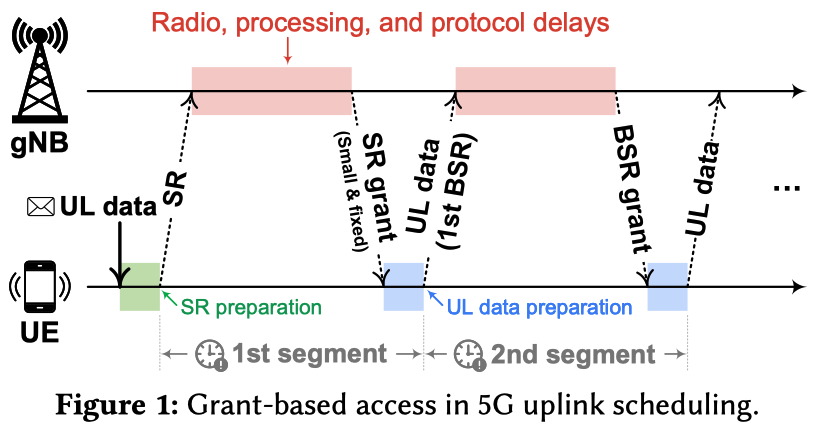
In today’s 5G networks, uplink data is sent through either grantbased or grant-free access. In grant-based access, shown in Fig. 1, the user must request permission to transmit by sending a Scheduling Request (SR), then wait for a grant, transmit a small initial packet with a Buffer Status Report (BSR), indicating the amount of data remaining in its buffer. It then waits again for another grant before sending the remaining data [19]. This incurs at least two round-trip delays, shown as the two latency segments in Fig. 1. In grant-free access, uplink resources are pre-allocated to the user such that it can transmit uplink data immediately [56], avoiding the need for the first segment in Fig. 1 and potentially the second segment if the preallocated resources are large enough to fit all the data. This reduces latency but wastes resources when there is no data to send [56]. Grant-based access, on the other hand, tends to be efficient in terms of allocated resources as it allocates exactly the amount of resources needed by each user at the cost of increasing latency. This problem is exacerbated in Non-Terrestrial Networks (NTNs) for direct-tosatellite 5G connections, where every extra transmission amplifies the latency due to the long propagation delays between devices and satellites [37, 72, 80].
The tradeoff between latency and efficiency is therefore fundamental. Grant-based access keeps devices waiting even when data is ready, while grant-free access wastes resources and cannot scale well with many users. Neither approach achieves both low latency and high efficiency [107]. In this paper, we show that it is possible to break this tradeoff by allowing the base station to predict when and how much data a user will send. If the base station can accurately forecast the upcoming traffic, it can pre-allocate just the right amount of resources at the right time, effectively skipping both latency segments shown in Fig. 1.
Prior research has explored traffic prediction in cellular networks [6, 9, 10, 31, 38, 51, 70, 81, 101, 105]. However, most work has focused on large time scales (minutes, hours, or even days) with offline prediction suitable for planning and load balancing, but not millisecond-level decisions. More recent works [83, 99] have proposed real-time prediction and latency reduction frameworks, but only support periodic traffic with small payloads of 100 bytes [83] or < 300 bytes [99] that fit in initial SR grants, as explained in §9.
Building an accurate real-time prediction system is challenging. The base station never sees the “real” traffic arrival process at the user. Instead, it only observes traffic arriving at the base station via SRs, BSRs, and received payloads, which are shaped and delayed based on the 5G protocol configurations, as well as retransmissions caused by decoding errors and packet loss. This distorted view of user-side uplink bursts at the base station makes traffic prediction hard and error-prone. Second, cellular networks must support a wide range of applications with highly different traffic patterns. A single general-purpose AI predictor would be too large to run within millisecond deadlines and too costly to retrain every time a new application emerges. Finally, implementing a fully functional system requires more than just prediction. The system must track prediction errors, adapt scheduling decisions on the fly, handle traffic that is challenging to predict, and update prediction modelsall under strict real-time constraints.
In this paper, we present Sage, a full AI system for millisecondscale uplink traffic characterization, prediction, and proactive scheduling in 5G Radio Access Networks (RANs) that does not require protocol or hardware modifications and can be implemented via software updates. Sage addresses the distorted view of user-side uplink bursts at the base station by proposing the concept of “traffic trains”, an abstraction that groups together closely spaced traffic arrivals based on SRs, BSRs, delivered payload sizes, and retransmission feedback. This simple abstraction largely filters out noise and distortions introduced by the 5G system, including buffer quantization, slot-level observability, radio-layer retransmissions, and system configuration diversity, while preserving the intrinsic burst structure of application traffic. It ensures that traffic trains observed at the base station closely track the underlying traffic arrival process at the user.
To handle diverse traffic patterns, Sage uses an AI model database of lightweight, profile-specific AI predictors instead of a single large universal model. Traffic is classified into profiles, each paired with a tailored model, enabling fast inference and incremental updates. Finally, to enable a fully functional system, Sage incorporates a control architecture that runs across the 5G base station, a realtime RAN Intelligent Controller (RIC), a near-real-time RIC, and a shared model database. Sage has five components: (1) Traffic Characterization to classify traffic and select an appropriate prediction model. (2) Model Verification to track prediction errors and confirm that the selected model continues to perform well. (3) Prediction and Scheduling to run inference and pre-allocate resources for incoming traffic when verification succeeds. (4) Continual Learning to incrementally adapt the model to current traffic when verification fails. (5) Database Updating to update the model database by training and registering new models when continual learning fails.
For hard-to-predict traffic patterns, Sage reverts to grant-based or grant-free access. For grant-free access, Sage introduces an analytical model and uses it to determine an appropriate grant size that balances the tradeoff between latency and resource consumption. Sage’s architecture ensures that prediction is used when it is reliable, suspended when it is not, and improved over time through model retraining and database updates.
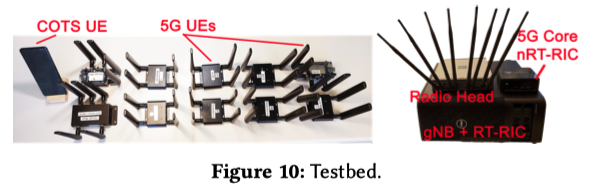
We implemented a prototype of Sage on our 5G testbed using the open-source srsRAN [78] software stack, which we extended with interfaces to our custom implementations of a real-time RIC and a near-real-time RIC. We further deployed all AI models in the ONNX format [63] to enable real-time inference and online training. We evaluated Sage over the air across several real-world applications, with non-periodic traffic, including surveillance cameras, mobile AR, SLAM, multiplayer games (Counter-Strike 2 and Team Fortress 2), Google Meet, WhatsApp, Zoom, and industrial automation.
Across all applications, Sage reduces latency by an average of 2.53× compared to grant-based access while using only 1.59× more resources. It achieves comparable latencies to grant-free baselines while using, on average, up to 37.5× fewer resources. With 10 concurrent commercial user equipment running heterogeneous applications, Sage reduces latency by 1.42–2.41× compared to grant-based access while using only 1.15–1.55× more resources. Sage achieves a Jain’s fairness index above 0.9902 across MAC schedulers and application-arrival rates. As the number of users increases from 2 to 10, Sage remains effective even under heavy load, reducing latency from 2.26× to 1.57× with only from 1.39× to 1.13× more resources, while preserving a Jain’s fairness index above 0.9937. For real-time video streaming, Sage reduces network latency per frame by 2.07–2.54× and end-to-end display latency by 1.13–1.23×. Sage predicts traffic arrival times with a median absolute error under 4 ms and arrival sizes with a median relative error under 20 %.
The paper makes the following contributions:
• It introduces the notion of traffic trains, an abstraction that reconstructs user-side uplink bursts from distorted base-station-side observations and yields a reliable prediction target.
• It presents a real-time AI system that performs millisecond-level prediction of traffic trains at the base station.
• It presents a full system architecture to reduce uplink latency in 5G RANs: traffic characterization, model verification, prediction and scheduling, continual learning, and database updating.
• It introduces an analytical model that characterizes the latencyresource tradeoff as a function of the guaranteed grant size.
• We implement and extensively evaluate Sage over the air.
Project webpage: https://sens.epfl.ch/research/sage
Ethical statement. This work does not raise any ethical issues.
-
背景与现有调度的两难困境
- 随着NextG网络的发展,上行链路延迟已成为众多现代应用(如AR/VR、云游戏等)的主要瓶颈
- 现有的5G上行调度面临延迟与效率的权衡:
- 基于授权(Grant-based)的接入机制虽然节省资源,但需要经过复杂的请求和等待过程,导致至少两次往返延迟(如Fig. 1所示)
- 而免授权(Grant-free)的接入机制虽然能降低延迟,却会在无数据时造成大量资源浪费
-
破局思路与现有方案的局限
- 核心思路: 如果基站能准确预测用户的数据到达时间和大小并主动预留资源,就能完美避开上述请求等待时间
- 现有局限: 先前的流量预测大多针对分钟/小时级别(非实时),而近期的实时预测方案又受限于只能处理极小的周期性流量(<300字节)
-
实时预测面临的三大挑战
- 观测失真: 基站看到的流量数据受 5G协议 和 丢包重传 的严重扭曲,无法反映用户端真实的流量到达过程
- 模型笨重: 单一的通用AI模型太大,无法满足毫秒级的推理要求,且难以适应多变的应用
- 系统缺失: 缺乏一个能在极短时间内处理预测、纠错、调度和在线学习的完整系统
-
SAGE 系统的核心创新
- “流量列车”(Traffic Trains)抽象:
- SAGE 提出将紧密相邻的流量请求整合为一个“列车”,过滤掉由于协议机制带来的噪音,还原真实的流量突发模式,从而提供可靠的预测目标
- 轻量级模型数据库:
- 不依赖单一庞大模型,而是根据不同应用的流量特征,匹配专属的轻量级AI模型,从而实现毫秒级推理
- 五大系统组件:
- 构建了包含流量特征提取、模型验证、预测与调度、在线持续学习、以及数据库更新的完整闭环控制架构
- 智能回退与分析模型:
- 针对难以预测的流量,SAGE 会自动回退到传统接入模式,并引入了一个分析模型来自动平衡免授权模式下的资源开销
- “流量列车”(Traffic Trains)抽象:
-
实验评估与主要贡献
- 在真实的5G测试床(srsRAN)下评估,SAGE 在多项应用中平均降低了 2.53倍 的上行延迟,而仅增加了 1.59倍 的资源分配
- SAGE 展现出了毫秒级的预测精度(时间误差中位数小于4毫秒,大小误差小于20%),并且在多用户并发时保持了极高的公平性(Jain's公平指数大于0.9902)
Background¶
The 5G standards refer to base stations as gNBs and user devices as User Equipment (UEs). The standards divide physical resources into frequency-time units called Resource Blocks (RBs). Unlike 4G, which uses fixed-duration time slots of 1 ms, 5G supports flexible slot durations through the numerology parameter 𝜇 , where \(𝑇_{slot} = 2^{−𝜇}\) ms. With Time Division Duplexing (TDD), each slot is explicitly configured as Uplink (UL) or Downlink (DL).
Uplink scheduling. Because the wireless medium is shared, the gNB must allocate radio resources among competing UEs, a process known as resource scheduling. For UL transmissions, a UE first waits for a Scheduling Request (SR) opportunity (which can take as long as 40 ms in commercial networks) and sends an SR to the gNB to indicate it has pending UL data. The gNB then allocates the UE an initial fixed grant, referred to as the SR grant and denoted by \(𝐺_{SR}\) . This initial grant allows the UE to transmit a small amount of data and report its remaining buffer occupancy through a Buffer Status Report (BSR). Although the specifications do not specify \(𝐺_{SR}\) [19], it must be sufficient to carry a BSR. A BSR is a 5 or 8 bits field that indicates the amount of data queued in the UE’s buffer. Based on this information, the gNB allocates additional resources to the UE in the earliest available UL slots. Choosing \(𝐺_{SR}\) involves a trade-off between latency (over-provisioning) and spectral efficiency (underprovisioning). For example, widely used open-source 5G Radio Access Network (RAN) implementations such as srsRAN [78] and OpenAirInterface [60] use SR grants of 512 bytes and 5 RBs, respectively, whereas commercial U.S. operators such as AT&T, Verizon, and T-Mobile typically use 2–3 RBs [83].
Application traffic isolation. A UE can run multiple applications simultaneously, some of which may have low-latency requirements while others do not. In 5G, up to 64 QoS Flow Identifiers (QFIs) are mapped by the SDAP layer to Data Radio Bearers (DRBs) [21]. UEs are mandated to support up to 16 DRBs, which are then mapped to 8 Logical Channel Groups (LCGs). Relevant control signals (e.g., BSRs) are sent per LCG [22]. Hence, one can guarantee traffic isolation by requiring an active low-latency application to be mapped to its own LCG. In practice, UEs run only a few concurrent low-latency applications, typically one. Not every application is required to be mapped to a dedicated LCG, only the foreground low-latency application. Other traffic can be multiplexed on the remaining LCGs, and the dedicated LCG can be reused once the application is no longer active. For simplicity, we will describe the paper assuming one low-latency application per UE.
RAN intelligent controller (RIC). Introduced by the O-RAN alliance [97], the RIC is responsible for controlling and managing radio resources. A RIC can operate at the non-Real-Time (non-RT), near-Real-Time (near-RT), or Real-Time (RT) level [5]. The non-RT RIC handles non-time-critical tasks, including network optimization and analytics. The near-RT RIC handles time-critical tasks such as radio resource management, dynamic network optimization, as well as AI/ML workflows [67]. Although the RT RIC is not yet formally standardized, it has been used for optimizations that require extremely short control-loop times and is therefore often co-located with the gNB [15, 44, 52, 85, 110].
(1) 5G 基础概念与资源划分
- 5G 标准中,基站被称为 gNB,用户设备被称为 UE
- 物理资源被划分为被称为资源块(RB, Resource Block)的时频单元
- 与 4G 固定的 1 ms 时隙不同,5G 通过参数灵活支持时隙持续时间
- 其计算公式为 \(T_{slot} = 2^{-\mu}\) ms
- 并在时分双工(TDD)中将每个时隙明确配置为上行链路(UL)或下行链路(DL)
(2) 传统的上行链路调度 (Uplink Scheduling)
由于无线介质是共享的,基站必须负责为产生竞争的 UE 分配资源
- 具体的上行发送流程为:
- UE 首先等待并发送调度请求(SR)\(\rightarrow\) 基站分配固定大小的初始授权(\(G_{SR}\))\(\rightarrow\) UE 使用该授权发送少量数据和缓冲区状态报告(BSR)\(\rightarrow\) 基站根据 BSR 反馈的剩余数据量,在最早可用的上行时隙中分配后续的额外资源
- \(G_{SR}\) 的大小设定是一个核心痛点:
- 它直接涉及到延迟(资源分配过剩)与频谱效率(资源分配不足)之间的权衡
- 目前的开源实现(srsRAN)与商业运营商(T-Mobile)在这方面的配置往往存在差异
(3) 应用流量隔离
- 一个 UE 可以同时运行多个应用,5G 通过将 QoS 流标识符映射到数据无线电承载(DRB),再进一步映射到最多 8 个逻辑信道组(LCG)来进行分类管理
- 因为核心的控制信号(如 BSR)是基于 LCG 发送的
- 所以只要将前台的低延迟应用映射到一个专属的 LCG,就可以实现与其他后台流量的物理层/MAC层隔离,避免互相干扰
QFI / DRB / LCG 这些概念的含义与关系
在 5G 网络中,数据从应用层向下传输到物理层,需要经过层层打包和分类。它们的对应关系是:应用层数据 \(\rightarrow\) QFI \(\rightarrow\) DRB \(\rightarrow\) LCG
(1) QFI (QoS Flow Identifiers. 服务质量流标识符)
- 概念:在 5G 中,系统最多支持 64 个 QFI。它相当于 数据的"优先级与服务要求标签"
- 比喻:
- 就像快递包裹上的“生鲜加急”、“易碎品”、“普通陆运”标签
- 用户手机上的不同应用(例如:低延迟的云游戏 vs 后台下载的大文件)产生的数据,会被打上不同的 QFI 标签,以区分它们的紧急程度
(2) DRB (Data Radio Bearers - 数据无线电承载)
- 概念:5G 协议(SDAP层)会将上述带有 QFI 标签的数据流映射到 DRB 上
- 手机(UE)按规定最多支持 16 个 DRB
- 它是实际承载并传输用户数据的无线电 "逻辑管道"
- 比喻:相当于运输快递的“专线货车”
- 不同标签(QFI)的包裹,会被分拣并装进对应的专线货车(DRB)里,准备跨越无线电波发往基站
(3) LCG (Logical Channel Groups - 逻辑信道组)
- 概念:为了方便管理,这最多 16 个 DRB 会被进一步打包映射到 8 个 LCG 中
- 最关键的是: 向基站报告"我还有多少数据要传"的控制信号(BSR) 是按 LCG 为单位发送的
- 比喻:相当于物流中心的“发货站台”
- 为了避免每辆货车单独向总调度室(基站)喊话导致混乱,几个货车(DRB)会被编成一组!
- 在一个站台(LCG)统一向上汇报当前站台还有多少货积压
因此, 可以直观体会到: DRB 是一个比 LCG 更细粒度的概念
为什么 LCG 对本文这么重要, 这里要大加笔墨?
gNB 是按 LCG(站台)来接收数据排队报告(BSR)的
如果把低延迟应用(比如正在玩的射击游戏)和普通应用(比如后台正在自动更新的软件)混在同一个 LCG 里, 基站收到的报告就是一笔"糊涂账"(基站收到的 BSR 报告, 只能反映该 LCG 的总数据量, 无法区分其中到底有多少是"急需传输的低延迟数据"),无法优先保障游戏的极速传输
因此,论文提出了一种流量隔离(Traffic isolation)的手段:
- 只要强制把正在运行的前台低延迟应用单独分配到一个专属的 LCG 中,就能保证它不受其他后台杂乱流量的干扰
- 当这个低延迟应用关闭后,这个专属的 LCG 还可以被回收再利用
(4) RIC 架构
开放无线接入网(O-RAN)联盟引入了 RIC 机制,用于控制和管理无线电资源
- RIC 架构分为三个层级:
- 非实时 (non-RT) RIC: 处理非时间关键任务
- 近实时 (near-RT) RIC: 处理 AI/ML 等时间关键任务
- 实时 (RT) RIC: 处理极短控制循环任务
- RT-RIC 通常与基站(gNB)并置部署,这也是 SAGE 能够实现毫秒级超低延迟 AI 预测的架构基础
Motivation for Traffic Trains¶
To efficiently perform real-time traffic prediction in NextG systems, it is critical to define prediction targets that are both efficient and robust. A natural choice is to use signals already available at the gNB side, including BSRs and Service Data Units (SDUs). When a UE transmits UL data, its MAC layer segments the data into SDUs, which the gNB then receives. These SDUs reflect the actual payload size being delivered across the radio link. At the same time, the BSR reflects the amount of data queued in the UE's buffer. However, they are unsuitable as prediction targets for two reasons. First, they do not reflect the UE-side arrival process: a single UE-side UL burst might be fragmented into multiple SDUs and trigger multiple BSRs when the allocated grant is insufficient to carry the burst within a single slot. This breaks the mapping between "what arrived at the UE" and "what the gNB observes," leading to redundant predictions for the same burst. Second, BSR and SDU values are entangled with system dynamics like system configurations, scheduling decisions, and modulation/coding schemes. Thus, the same UE-side UL burst can yield very different BSR/SDU values under different network settings. As shown in Fig. 2, changing only the channel bandwidth (from 40 to 60 MHz) can substantially alter the sequence of SDUs and BSRs. This dependency reduces the generalizability of AI predictors and increases the amount of training data needed to cover diverse runtime conditions.
A more stable alternative is for the gNB to derive UE-side UL bursts from BSRs and SDUs, and use these reconstructed events as prediction targets. We refer to this event as a derived traffic arrival: an inferred arrival at the UE buffer computed by the gNB from two consecutive BSRs and the SDUs transmitted in between. Specifically, given two consecutive BSRs and the SDUs transmitted in between, the arrival size of this derived traffic arrival is:
with the arrival time defined as the time slot in which the current BSR is received. As shown in Fig. 3(a), this abstraction filters out system-dynamic effects largely and yields a more consistent view of traffic demand. However, it still suffers from two limitations. The first limitation is the quantized nature of BSRs. BSRs are encoded in discrete levels [19], which mask small buffer changes. For instance, any buffer size between 3910 and 5446 bytes maps to BSR index 20, which the gNB interprets as 5446 bytes. As long as transmissions keep the buffer within this range, the reported BSR index remains unchanged, and the gNB may falsely derive new traffic arrivals even though no new data has actually arrived at the UE buffer, as shown in Fig. 3(b). We define these arrivals as ghost arrivals, which inject noise that degrades prediction accuracy by distorting inter-arrival statistics. The second limitation is that derived traffic arrivals are fundamentally constrained by slot-level observability. When a single UE-side UL burst spans multiple time slots, as shown in Fig. 2, it can result in multiple derived traffic arrivals. This fragmentation can distort inter-arrival statistics and trigger redundant back-to-back predictions for the same UE-side UL burst.
为什么直接看 gNB 侧原始数据行不通? (BSR 与 SDU)
- 碎片化错觉:
- 工厂明明一次性生产了 1 大批货(一次真实的流量突发),但网络分配的卡车每次只能装一点点(SDU),工厂只能不断打电话报告“我还剩多少货”(BSR)
- 仓库的 AI 看着这一辆辆小卡车,会误以为是“多次零星的小发货”,导致错误预测
- 受外界干扰大:
- 如果今天换了更大的卡车(相当于改变了 5G 网络的信道带宽),卡车到达的频率和工厂报告的次数就会完全改变
- 同样的一批货物,却呈现出完全不同的表象,这会让 AI 无所适从
为了撇除表象,仓库试图用数学公式推导真实的产出量: "新到货物 = 当前剩余 + 已运走 - 之前剩余",即:
“幽灵”数据(量化误差)
问题在于: 报告信息是 "量子化" 的, 是阶跃而非连续的
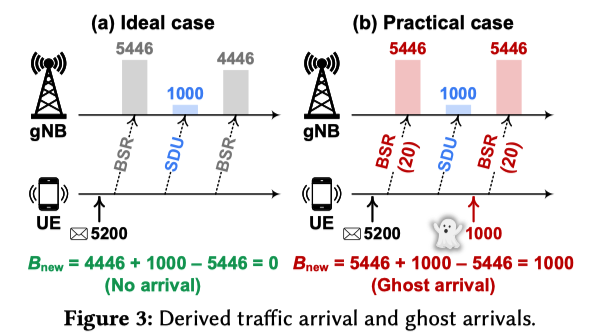
工厂报告库存时(BSR)给的不是精确数字,而是“档位”(比如 3910-5446 件统称为 20 档)
如果实际库存从 4000 降到 3950,档位没变,仓库一算公式,就会算出凭空出现了不存在的“幽灵货物(Ghost arrivals)”,严重干扰 AI 的判断
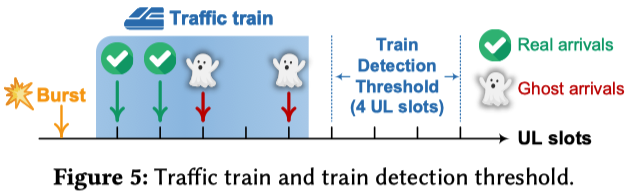
To overcome these limitations, we introduce the concept of traffic trains. Specifically, traffic trains group closely spaced derived traffic arrivals to recover a clearer view of the underlying UE-side arrival process, while minimizing distortions introduced by cellular systems. A traffic train is defined as a sequence of derived traffic arrivals, followed by an idle period consisting of a pre-defined number of consecutive UL slots with no derived traffic arrivals, as shown in Fig. 5. This parameter, referred to as the train detection threshold, is configurable at the slice level. Lower thresholds can be used for URLLC slices to capture short bursts that may complete within a single UL slot, while higher thresholds are suitable for eMBB slices to aggregate larger bursts that usually span multiple UL slots. The arrival time of a traffic train is defined as the time at which its first derived traffic arrival is observed following the idle period. Once a new traffic train is detected, this train is considered to end at this detection point. The size of this traffic train is computed using only information available before the detection point. Specifically, it is the total size of SDUs transmitted from the beginning of the train up to the slot at which the final BSR before the detection point is observed, plus the value of that final BSR, minus the value of the last BSR received before the beginning of the train:
Since this final BSR corresponds to the lowest BSR level observed before the detection point, the impact of BSR quantization is minimized for the train. Moreover, by decoupling traffic train detection and its size estimation, we enable early train termination for timely prediction without waiting for the remaining SDUs to be sent.
如何计算 Traffic Train Size?
不要被这串英文吓到,它其实就是最基础的库存盘点逻辑。
我们要算的是“这一波突发(这列火车),工厂到底新生产了多少货?
- Pre-train BSR(期初库存):
- 在发这波货之前,工厂仓库里原本剩了多少货
- \(\sum(\text{SDUs up to final BSR})\)(已发出的货):
- 在这波发货期间,已经成功运到我们 gNB 的总货量
- Final BSR(期末库存):
- 这波发货快结束时,工厂最后一次报告的剩余库存
计算逻辑: 新生产的货 = (已经运走的货 + 厂里还剩的货) - (发货前厂里原本就有的货)
为什么非要这么算?
在发这波货的过程中,工厂可能会打十几次电话汇报库存(产生十几个中间的 BSR)。正如前面说的,这些库存数字是“分档位”的,极度不精确
为了避免被中间那些忽上忽下的粗略汇报给骗了,系统干脆无视中间所有的汇报!!!
它只看“发货前”和“发货快结束时”的两个端点状态,加上中间实际收到的货量来算总账
这种“秋后算账”的方式,把库存数字模糊带来的误差降到了最低
SAGE can also use SRs to improve traffic-train reconstruction. Unlike BSRs and SDUs, an SR does not reveal the amount of buffered data, but it indicates that the UE has UL demand before the corresponding BSRs or SDUs become observable at the gNB. Therefore, when an SR is received after an idle period longer than the train detection threshold, SAGE instantiates a provisional traffic train whose arrival time is the SR slot and whose size is finalized once the subsequent BSRs and SDUs are observed.
Traffic trains provide a simple yet powerful abstraction that is not only robust to the diverse system configurations, BSR quantization, and slot-level observability distortions discussed earlier, but also to packet loss and retransmissions. Our traffic train detection exploits Hybrid Automatic Repeat Request (HARQ) processes (a MAC-layer mechanism that allows the gNB to keep track of outgoing grants and request retransmissions for failed packets [19]) as a source of temporal ground truth. In particular, while retransmission delays the successful delivery of SDUs, HARQ preserves the history of all transmission attempts, including the slot of the initial attempt. As a result, although an SDU will only become observable at the gNB after successful decoding, its initial transmission time can be recovered retroactively. We leverage this property to correct the temporal placement of retransmitted SDUs by combining their recovered initial-attempt slot with their sizes obtained upon successful decoding. Retransmitted SDUs can either instantiate new traffic trains that were previously missed because of delayed observations, as shown in Fig. 4a; correct errors in existing trains by adjusting their arrival time and/or sizes, as shown in Fig. 4b and 4c; or merge trains that were previously separated due to packet loss. Specifically, this correction is made by computing (i) \(G1\): the gap between the recovered initial-attempt slot and the end of the previous train, and (ii) \(G2\): the gap between the recovered initial-attempt slot and the beginning of the next train. Letting \(th\) be the train detection threshold, we have
- \(G1\ge th\) and \(G2\ge th\Rightarrow\) instantiate missed train (Fig. 4a).
- \(G1\ge th\) and \(G2<th\Rightarrow\) correct next train (Fig. 4b).
- \(G1<th\) and \(G2\ge th\Rightarrow\) correct previous train (Fig. 4c).
- \(G1<th\) and \(G2<th\Rightarrow\) merge previous and next trains.
Taken together, traffic trains provide a stable abstraction of UE-side UL bursts by filtering out artifacts. This abstraction can transform noisy, fragmented MAC-layer observations into a sequence of burst-level events, facilitating predictions.
HARQ 机制是如何像"时光机"一样缝合数据的?
HARQ 是 5G 底层的一个重传机制
在正常情况下,如果一辆卡车(数据包)在路上翻车了(信号不好导致解码失败),基站会要求手机重新发一次
(1) 没有 HARQ 会怎样?
假设工厂 12:00 发了一车货,失败了;12:05 重新发,这次基站收到了
基站会傻傻地以为:“哦,工厂在 12:05 产生了一批新流量。”
这就导致基站记录的时间完全错位,预测模型也会跟着学歪...
(2) HARQ 是怎么变成“时光机”的?
HARQ 有个特性:它会保留所有传输尝试的历史记录,包括第一次尝试发送的时隙
也就是说,12:05 到的那辆重传卡车上,贴着一张单子,写着:“原定出发时间:12:00”
基站看到这张单子后,就会启动“时光机”进行后台账目篡改(retroactive correction):

-
插入遗漏的列车(对应论文的 Fig. 4a):
- 如果基站翻看 12:00 的记录,发现当时根本没有列车(可能当时所有的包都丢了)
- 基站就会在 12:00 这个时间点凭空新建一列火车,把这车货塞进去
-
修正大小(对应论文的 Fig. 4b / 4c):
- 如果 12:00 附近本来就有记录在案的列车,基站就会说:“原来这车货是属于那列火车的啊!”
- 然后直接把这批货的体积,加到当时那列火车的总容量里
-
合并断开的列车:
- 有时候因为中间丢包太多,基站以为工厂在 11:59 发了一列车,12:01 又发了一列车(中间因为丢包出现了假空隙)
- 当重传的卡车带着“12:00”的时间戳到达时,基站一看,正好填补了中间的空隙!!!
- 于是判定:“这根本不是两列火车,而是一列超长火车!”从而把它们合二为一
通过这两套机制,基站硬是把破烂不堪的原始数据,洗成了一份完美的时间序列表格!
System Overview¶
In this section, we present an overview of our system, beginning with the definition of three operational modes:
(1) Grant-based mode: the gNB allocates resources to a UE based on SRs and BSRs.
(2) Grant-free mode: the gNB continuously allocates a guaranteed amount of resources to a UE in every UL slot.
(3) Prediction mode: the gNB forecasts upcoming traffic trains, including their arrival times and sizes, based on the most recent observations. It then proactively allocates resources to the UE according to the prediction results.
- 基于授权模式 (Grant-based mode):基站基于 SR 和 BSR 信号为用户分配资源
- 免授权模式 (Grant-free mode):基站在每个上行时隙中持续为用户分配固定保证量的资源
- 预测模式 (Prediction mode):基站预测即将到来的流量列车的到达时间和大小,并根据预测结果主动分配资源
- 本文重磅推出
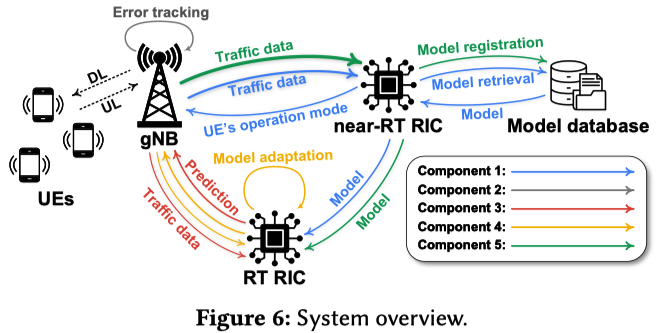
After establishing a connection between the gNB and a UE, the system will traverse five components, as shown in Fig. 6.
Component 1 – Traffic Characterization: The gNB initially assigns the UE to grant-based or grant-free mode and collects a time series of the UE’s traffic trains. This time series is then forwarded to the near-RT RIC, which stores it and triggers the model-selection pipeline once a predefined volume is reached. The pipeline first applies the Augmented Dickey-Fuller test [12, 13] to assess whether the time series is stationary. If the time series is stationary, the nearRT RIC extracts a feature vector, identifies the most similar traffic profile through similarity matching, and retrieves the corresponding prediction model from the model database, as shown in Fig. 6 and detailed in §5.1. The selected model is then forwarded to the RT RIC for subsequent tasks. If the time series is non-stationary (i.e., difficult to predict), the near-RT RIC instructs the gNB to assign the UE to grant-based or grant-free mode according to slice-specific policies. For UEs operating in grant-free mode, we develop an analytical model that characterizes the trade-off between latency and resource consumption to determine appropriate grant sizes. The mathematical derivation of this analytical model is provided in App. A1.
Component 2 – Model Verification: The gNB keeps the UE in grant-based or grant-free mode and starts submitting its inference tasks to the RT RIC, which executes the assigned prediction model on the collected traffic. Specifically, it performs inference to predict future traffic trains and returns the prediction results to the gNB. The gNB quantifies the prediction error by comparing the results against detected traffic trains. As detailed in §5.3, once a sufficient number of predictions have been evaluated, the gNB assesses if the model’s performance satisfies a predefined accuracy threshold.
Component 3 – Prediction & Scheduling: If the model passes verification, the gNB assigns the UE to prediction mode, enabling proactive UL resource allocation based on predicted traffic trains. The gNB continues to track the prediction error after assigning the UE to prediction mode, verifying if the performance remains above the threshold.
Component 4 – Continual learning: Conversely, if the model fails verification, the system triggers continual learning. During this period, the gNB assigns the UE to grant-based or grant-free mode and uses the most recent traffic trains to incrementally update the model through supervised learning in the RT RIC as detailed in §5.2. Each continual-learning step is immediately followed by an inference step, after which the updated model is re-evaluated as in Component 2. This cycle, spanning Components 2–4, iteratively continues as the system adapts to the UE’s traffic.
Component 5 – Database updating: If continual learning fails to improve the model’s performance after repeated attempts, the gNB requests the near-RT RIC to update the model database. Specifically, the near-RT RIC trains the model on a longer time series of traffic trains and registers the resulting model, together with its feature vector, as a new entry in the database, as described in §5.4. Once training is complete, the near-RT RIC forwards the new model to the RT RIC, enabling subsequent prediction and evaluation as in Components 2 and 3. If the new model still fails, the gNB assigns the UE to either grant-based mode or grant-free mode using a grant size determined by the analytical model derived in App. A1.
We analytically analyze the impact of Sage on airtime utilization and fairness during the bootstrapping phase (grant-based and grant-free modes) and the steady-state phase (prediction mode) under varying churn rates, numbers of UEs, and bitrates. The mathematical derivation is given in App. A2. We plot the reservation overhead in Fig. 7a as a function of churn rate for varying grant sizes during grant-free bootstrapping. In contrast, grant-based bootstrapping incurs no such overhead. During the steady-state phase, SAGE incurs, on average, a constant multiplicative over-provisioning overhead. The aggregate overhead increases linearly with the number of UEs, as shown in Fig. 7b. This overhead reduces the number of UEs supportable before airtime saturation, compared to grant-based access.
-
组件 1 - 流量特征提取 (Traffic Characterization):
- 基站最初将用户分配为基于授权或免授权模式,并收集流量列车的时间序列数据
- 近实时 RIC (near-RT RIC) 接收数据后,判断时间序列是否平稳
- 如果平稳,则提取特征向量,通过相似度匹配找出对应的预测模型并发送给 RT-RIC
- 如果不平稳,用户将保持传统模式,若是免授权模式,则使用一个数学分析模型来计算合适的资源授权大小
-
组件 2 - 模型验证 (Model Verification):
- 用户暂且保持原有模式,RT RIC 开始执行后台预测任务并将结果返回给基站
- 基站通过将 "预测结果" 与 "实际检测到的流量列车" 进行对比来量化误差,评估模型是否满足精度阈值
-
组件 3 - 预测与调度 (Prediction & Scheduling):
- 如果模型通过了上述验证,用户正式被切换到预测模式,基站开始主动进行上行资源分配
- 在此期间,基站会持续跟踪预测误差以确保模型不失效
-
组件 4 - 持续学习 (Continual learning):
- 如果模型验证失败,系统触发持续学习机制
- 此时, 用户回退到基于授权或免授权模式,系统使用最新的流量列车数据在 RT RIC 中通过监督学习对模型进行增量更新
- 随后重新进入验证环节,形成循环
-
组件 5 - 数据库更新 (Database updating):
- 如果持续学习反复失败,基站会请求 near-RT RIC 使用更长的时间序列重新训练模型,并将其作为新特征条目注册到模型数据库中
- 如果新模型仍然失败,用户将最终回退到由分析模型决定参数的传统模式
这套方法论非常常见, 积累!!!
- 流量特征提取
- 看看当前流量负载与"模板中的哪些"对得上?
- 模型验证
- 看看"套用模板"和"实测"差距如何?
- 预测、推理、调度 (实际工作)
- 实际工作
- 持续学习 / 增量更新
- 增量更新, 确保"模型泛化性在线"
- 数据库更新
- 学习 + 形成 更多"模板"
System Design¶
omitted
Implementation¶
Our system targets the RAN part of the 5G network, using an off-the-shelf core network (Open5GS [48]). It includes one or more gNBs, an RT RIC co-located with each gNB, a near-RT RIC, and a model database. All components are containerized with Docker [14], orchestrated with Kubernetes [87], and deployed via Helm [86].
gNB and RT RIC. We build upon the open-source gNB implementation srsRAN [78] with four key capabilities: (i) metric-collection functionality to collect traffic trains, (ii) an error-tracking mechanism that monitors prediction quality and triggers operationalmode switching, (iii) a communication module using ZeroMQ [103] and Protobuf [28] for communication with the RIC, and (iv) slicing functionality that enables traffic classes to operate in isolation under different policies and operational modes. A lightweight RT RIC, co-located with the gNB, is implemented in C++ with a task scheduler that enables low-latency AI execution.
Near-RT RIC. The near-RT RIC is a centralized controller that manages multiple gNBs. It stores time-series data, applies statistical analysis, retrieves prediction models, and runs the analytical model for grant-free mode. When triggered by a gNB, it can retrain models on larger datasets. We implement the near-RT RIC in C++ with the modular xApp framework, where each xApp runs as an independent process and communicates with gNBs through ZeroMQ and Protobuf. Traffic-train time series are stored in TimescaleDB [88] and accessed through an API. The model database is implemented as a repository of prediction models and their feature vectors, organized and indexed using JSON metadata.
AI models. All models are represented in the Open Neural Network Exchange (ONNX) format, a widely supported standard that decouples models from specific training frameworks and enables execution across platforms and languages [63]. Using ONNX Runtime accelerates both inference and training, making AI tasks practical for real-time operation in the RAN. To integrate models, we implement lightweight C++ modules. These modules enable the RICs to load and execute models, while handling input/output conversion between ONNX tensors and standard data structures. AI models function as plug-ins that integrate seamlessly with Sage.
详细介绍了 SAGE 系统在实际测试平台中的软件栈与工程实现细节:
-
系统整体部署栈:
- SAGE 系统专注于 5G 网络的无线接入网(RAN)侧,并结合了现成的 Open5GS 核心网
- 其所有系统组件(gNB、RT RIC、near-RT RIC 和模型数据库)均使用 Docker 实现了容器化,通过 Kubernetes 进行集群编排,并使用 Helm 进行部署管理
-
基站 (gNB) 与 实时 RIC (RT RIC) 的深度定制:
- 基站是在开源项目 srsRAN 的基础上扩展而来的,专门增加了四大核心能力:
- 用于收集流量列车数据的指标收集功能
- 用于监控预测质量并触发模式切换的误差跟踪机制
- 基于 ZeroMQ 和 Protobuf 的高效通信模块
- 保障不同流量类隔离的网络切片功能
- 为了保障毫秒级的实时性,与基站并置的 RT RIC 采用 C++ 编写,并内置了针对低延迟 AI 执行优化的任务调度器
- 基站是在开源项目 srsRAN 的基础上扩展而来的,专门增加了四大核心能力:
-
近实时 RIC (Near-RT RIC) 的框架构建:
- 它作为集中式控制器,负责管理多个基站的数据流
- 其底层采用 C++ 和模块化的 xApp 框架开发,各个功能作为独立进程运行,同样通过 ZeroMQ 和 Protobuf 与基站进行通信
- 在数据存储方面,流量时间序列数据被安全存储在 TimescaleDB 中,而模型数据库则通过 JSON 元数据进行快速的组织与索引检索
-
AI 模型的标准化与“即插即用”集成:
- 为了摆脱特定 AI 训练框架的限制并实现跨平台兼容,所有模型均统一使用 ONNX(开放神经网络交换)格式
- 系统利用 ONNX Runtime 来加速实际的推理和在线训练过程
- 同时,作者开发了轻量级的 C++ 接口模块来处理底层张量(tensors)与标准数据结构间的转换,使得各类 AI 预测器能像“插件”一样顺滑地集成进 SAGE 系统中
evaluation¶
积累一下人家的 experimental setup / dataset 即可
Related Work¶
Various models have been developed for cellular traffic prediction, which fall into three categories: statistical, machine learning, and deep learning. Among statistical models, exponential smoothing models [71, 76, 77, 90] have been widely used for cellular traffic prediction for admission control and resource management. Classical machine learning models, such as random forest and Gaussian process regression, have also been applied to cellular traffic prediction [81, 101, 105]. Deep learning models, such as feedforward neural networks [3, 43], convolutional neural networks [7, 25, 57, 104], and Recurrent Neural Networks (RNNs) [34, 35, 4547, 58, 75, 82, 102, 108], often outperform these approaches in many cellular traffic-prediction tasks [9, 51]. Most of this work, however, has focused on much longer timescales (minutes, hours, even days) and high-level patterns and is therefore not designed to predict cellular traffic at millisecond granularity.
The closest to our work is [99], which predicts the next 100 UL payloads (based on the previous 1000 slots) to proactively allocate grants and reduce the need for SRs. However, [99] employs a large model that requires 15 to 35 ms per inference when run on a powerful GPU edge server. Moreover, it has been tested only on highly periodic, small-payload traffic (< 300 bytes) [64, 65]. In contrast, Sage provides slot-level predictions using lightweight models, with an average inference latency of 0.051 ms in an end-to-end system that supports automated traffic classification and error tracking.
LRP [83] proposes reducing uplink latency from the UE side by having the UE send a dummy packet ahead of an actual packet arrival. This dummy packet triggers the UE’s 5G module to send an SR in advance and receive a grant in time for the actual packet. LRP only requires modifications to UE applications. However, it only supports periodic traffic with known inter-arrival times and sizes smaller than 100 bytes, which avoids the need to predict traffic but significantly limits the range of applications that LRP can support. Sage, on the other hand, focuses on the gNB, predicts traffic sizes to allocate the right amount of resources, and is not limited to periodic or small traffic.
Finally, prior work [1, 74] proposes reactive mechanisms that use SR/BSR signaling to more accurately track the UE’s buffer status and avoid outdated BSR values, which can happen in applications with continuous traffic arrivals like file uploads. However, such an approach cannot avoid the two latency segments shown in Fig. 1, which are usually the bottleneck for bursty or periodic traffic. In contrast, Sage takes a complementary proactive approach: by predicting traffic trains directly, it bypasses SRs and BSRs.
(1) 现有流量预测模型在“时间粒度”上的局限
- 现有的蜂窝网络流量预测模型主要分为三大类:
- 统计模型
- 机器学习模型
- 深度学习模型(通常表现最佳)
- 局限性:
- 这些研究绝大多数都聚焦于宏观的时间尺度(如分钟、小时甚至天),旨在识别高维度的模式
- 根本无法胜任 SAGE 所追求的毫秒级实时流量预测
(2) 与最相似的预测系统(文献 [99])的对比
- 文献 [99] 是与 SAGE 最接近的工作,它也通过预测未来的上行负载来主动分配资源并减少 SR(调度请求)的需求
- 局限性:该方案使用的是庞大的模型
- 即使在强大的 GPU 边缘服务器上运行,单次推理也需要 15 到 35 毫秒
- 此外,它只能处理高度周期性且负载极小(小于 300 字节)的流量
- SAGE 的优势:
- SAGE 采用轻量级模型,平均推理延迟仅为 0.051 毫秒,并提供了一个包含自动流量分类和误差跟踪的完整端到端系统
[99]
Robin Wiebusch, Niklas A. Wagner, Dennis Overbeck, Fabian Kurtz, and Christian Wietfeld. 2023. Towards Open 6G: Experimental O-RAN Framework for Predictive Uplink Slicing. In ICC 2023 - IEEE International Conference on Communications. IEEE, Rome, Italy, 4834–4839. https://doi.org/10.1109/ICC45041. 2023.10279730
有空得看看
(3) 与终端侧优化方案(LRP [83])的对比
- LRP 方案试图从终端(UE)侧降低延迟,其做法是让 UE 在真实数据包到达前先发送一个“虚拟数据包”,提前触发 5G 模块发送 SR
- 局限性:这种方法只适用于到达时间已知且大小非常小(小于 100 字节)的严格周期性流量,适用场景极其有限
- SAGE 的优势:SAGE 部署在基站(gNB)侧,不仅能预测流量大小以精准分配资源,而且不局限于周期性或小负载流量,适用范围更广
[83]
Zhaowei Tan, Jinghao Zhao, Yuanjie Li, Yifei Xu, and Songwu Lu. 2021. Device-Based LTE Latency Reduction at the Application Layer. In 18th USENIX Symposium on Networked Systems Design and Implementation (NSDI 21). USENIX Association, Virtual, 471–486. https://www.usenix.org/conference/nsdi21/ presentation/tan
有空得看看
(4) 与被动反应机制(文献 [1, 74])的对比
- 部分早期工作提出通过优化 SR/BSR 信号处理,来更精准地跟踪终端的缓冲区状态,防止 BSR 值过期
- 局限性:
- 这种被动的反应机制本质上依然是在传统的请求框架内修补,无法避开传统的两段等待延迟(如 Fig. 1 所示)
- 而这两段延迟正是突发流量的瓶颈所在
- SAGE 的优势:
- SAGE 采取的是一种互补的主动(proactive)策略,通过直接预测“流量列车”,完全跳过了繁琐的 SR 和 BSR 信号交互阶段
Conclusion & Future work¶
We presented Sage, a real-time AI system that reduces uplink latency in 5G RANs through millisecond-level traffic prediction and proactive scheduling. Sage introduces traffic trains, an abstraction that addresses distortions in gNB-side observations introduced by 5G systems and yields a reliable prediction target. Extensive evaluation shows that Sage achieves low uplink latency while maintaining high resource efficiency. Several points are worth discussing:
Bootstrapping modes. The choice between grant-based and grantfree bootstrapping creates a trade-off between scalability and trafficcharacterization quality. Grant-based bootstrapping preserves fairness by allocating only requested resources. However, waiting for SR opportunities may delay gNB-side observations, especially under long SR periods, and thus increase uncertainty during traffic characterization. In contrast, grant-free bootstrapping provides cleaner gNB-side observations, since UL opportunities are preallocated and do not depend on SR opportunities. However, it can reduce capacity available to competing UEs under load.
Operators can select the bootstrapping mode according to slicespecific policies. For latency-critical traffic classes, operators can use grant-free bootstrapping to obtain cleaner gNB-side observations and provide low-latency fallback behavior. For delay-tolerant or resource-constrained traffic classes, operators can select grantbased bootstrapping to preserve fairness and spectrum efficiency. Improving traffic-train detection under long SR periods is an important direction for reducing the characterization uncertainty of grant-based bootstrapping.
Channel prediction. Sage focuses on traffic prediction. A complementary direction is to incorporate channel prediction. Forecasting channel quality could allow the system to adapt grant sizes (in RBs) or adjust prediction windows in real time, helping proactive scheduling remain efficient and reliable under fading and interference.
Integration with slice-level scheduling. Our current design focuses on predictive scheduling within a slice. In multi-slice systems, however, predictions from different slices may compete for shared resources, and coordination becomes necessary. One way is to introduce hierarchical scheduling: the near-RT RIC could first aggregate predictions into slice-level demand estimates and then allocate resources across slices according to their priorities and requirements. Within each slice, Sage can still optimize per-UE scheduling.
本文提出了 SAGE,这是一种 通过毫秒级流量预测与主动调度来降低 5G 无线接入网(RAN)上行链路延迟的 RT AI System
SAGE 引入了“流量列车”(traffic trains)这一抽象概念,旨在解决 5G 系统为基站(gNB)侧观测带来的失真问题,从而提供可靠的预测目标
广泛的评估表明,SAGE 在保持高资源效率的同时,实现了极低的上行链路延迟。以下几点值得进一步探讨:
(1) 引导模式 (Bootstrapping modes) * 在基于授权(grant-based)和免授权(grant-free)引导模式之间进行选择,本质上是在系统可扩展性与流量特征提取质量之间进行权衡 * 基于授权的引导模式仅分配终端请求的资源,从而保障了公平性 * 然而,等待调度请求(SR)机会可能会导致基站侧的观测出现延迟(尤其是在较长的 SR 周期下),进而增加流量特征提取过程中的不确定性 * 相比之下,免授权引导模式预先分配上行链路(UL)传输机会,不依赖于 SR 机会,因此能为基站侧提供更为纯净的观测数据 * 但在高负载情况下,该模式会减少其他处于竞争状态的用户设备(UE)的可用网络容量
运营商可根据特定网络切片的策略来灵活选择引导模式:
- 针对延迟敏感型流量类别,运营商可采用免授权引导模式,以获取更精准的基站侧观测数据,并提供低延迟的回退机制
- 对具有延迟容忍度或资源受限的流量类别,运营商则可选择基于授权的引导模式,以保障公平性及频谱效率
针对较长 SR 周期的情况,优化“流量列车”的检测机制,是降低基于授权引导模式下特征提取不确定性的重要研究方向
(2) 信道预测(Channel prediction)
SAGE 系统的核心在于流量预测。引入信道预测将是一个极具价值的互补方向。
通过预测信道质量,系统可以实时动态调整授权资源大小(以 RB 为单位)或预测窗口,从而确保主动调度机制在面临信道衰落和信号干扰时依然保持高效与可靠。
(3) 与切片级调度的集成(Integration with slice-level scheduling)
本文当前的设计 主要聚焦于单一网络切片内 的预测性调度。
然而,在多切片系统中,来自不同切片的预测请求可能会竞争共享资源,因此必然需要引入协同机制。
一种可行的方案是引入分层调度机制:
近实时 RIC(near-RT RIC)可以首先将预测结果聚合为切片级别的需求评估,随后根据各切片的优先级与需求在其间进行资源分配。
在此框架下,SAGE 依然能够独立优化单一切片内针对每个 UE 的调度过程。